






A 72-hour playbook from Friday setup to Monday launch, using TapVault as the non-custodial foundation.

 By Admin
 2026-05-04
How to Launch a P2P Bitcoin Marketplace This Weekend — Free Code, Zero Custody Risk
If you have ever thought about launching a peer-to-peer Bitcoin marketplace, the math probably stopped you. A custom build runs $40,000 to $100,000 and takes 3 to 6 months. The legal review around money transmission alone can cost more than the technical work. And once you ship, you are in the business of holding other people's Bitcoin — which means insurance, audits, and the constant low-level dread of being one bad day away from a headline.
None of that is necessary in 2026.
This post is a concrete plan: how a competent developer or technical founder can launch a working P2P Bitcoin marketplace between Friday evening and Monday morning, using only free tools, while completely sidestepping the custodial-money-transmitter trap. The trick is non-custodial design, and the foundation is TapVault.
The 72-hour timeline
Here is the realistic plan, hour by hour:
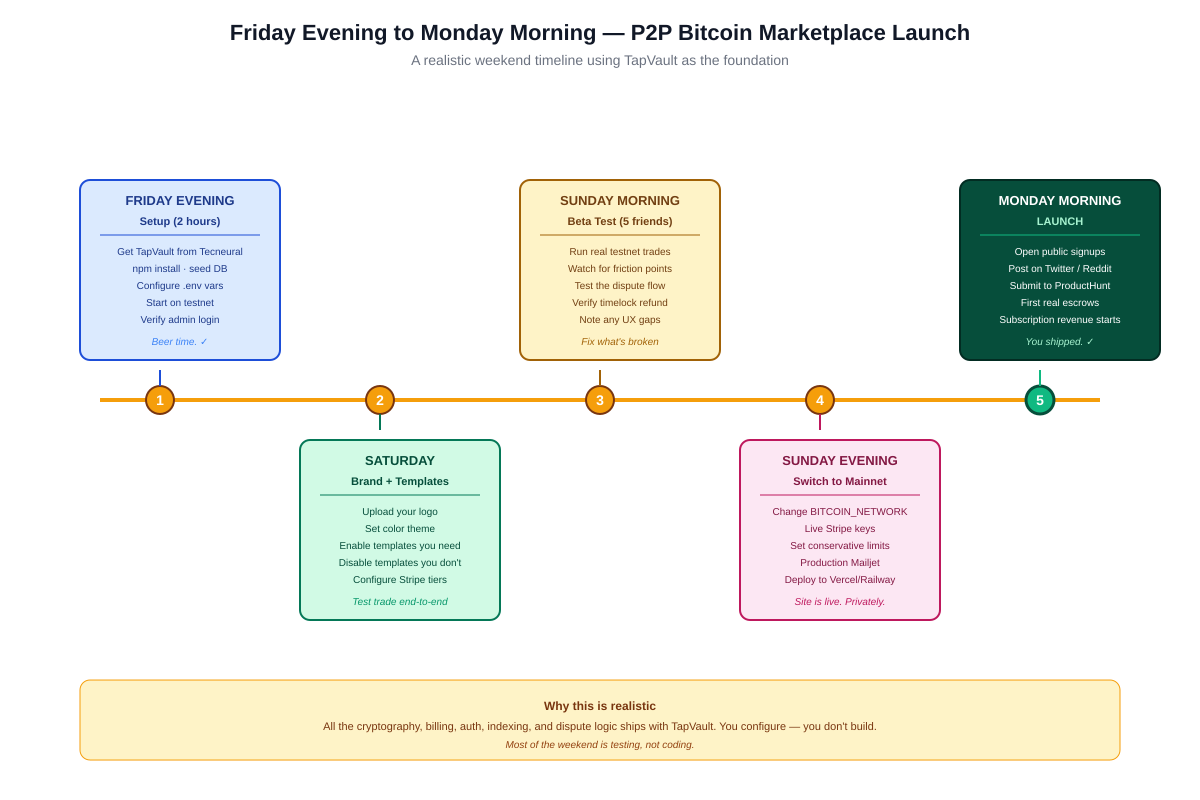
Each phase is short on purpose. The hardest engineering problems — Taproot multisig, PSBT construction, address derivation, dispute workflows, billing — are already solved in TapVault. Your job is configuration and branding, not implementation.
Friday evening — 2 hours of setup
Get the TapVault repository from Tecneural. Run the standard Node setup: npm install, copy .env.example to .env, fill in the variables. The README walks through every variable and what it does. The minimum to get running on testnet: MongoDB connection string (free tier on Atlas works fine for testing), NextAuth secret (generated with openssl), admin email and password for the seeded admin account, BITCOIN_NETWORK set to testnet, COIN_TYPE to 1, BLOCKBOOK_URL to a public testnet indexer, Stripe test keys, and Mailjet API keys.
Run npm run seed to create the admin user, default subscription plans, and template definitions. Then npm run dev. Log in. You should see the admin dashboard.
If you are stuck on a dependency or environment variable, the Tecneural team will jump on a 30-minute call to unblock you. That offer comes with the free distribution. Use it.
Saturday — branding and template configuration
This is where you make TapVault feel like your platform, not a clone. Three things matter:
1. Brand identity
Upload your logo (light and dark variants). Set your primary color in the theme config. Update the platform name throughout — it is one config file, not a hundred string replacements. Tweak the tagline on the landing page. By Saturday afternoon, the platform should look like yours, not ours.
2. Templates — enable what you need, kill what you do not
TapVault ships with six templates:
| Template | Best for | Key feature |
|---|---|---|
| Quick Trade | BTC ↔ fiat P2P trades, OTC desks | 60-second setup, fast confirmation flow |
| Freelance | Service marketplaces, contractor platforms | Milestone-based releases (partial payments) |
| Digital Product | Domain sales, license keys, NFTs | Verification step before release |
| Physical Product | Goods marketplaces, classifieds | Shipping tracking integration |
| Rent / Deposit | Short-term rentals, security deposits | Scheduled monthly slots, configurable timelock |
| Custom | Anything that does not fit the above | Configurable fields, rules, timelocks |
If you are launching a P2P trading platform, enable Quick Trade and disable everything else. If you are building a freelance marketplace, enable Freelance. If you are building a domain marketplace, enable Digital Product and customize the verification flow. The decision matters because every visible template that does not match your use case is friction for your users.
3. Pricing tiers
Stripe is wired in. Configure your three tiers — Free, Pro, Enterprise — with whatever monthly prices and escrow limits make sense for your market. The defaults ($0 / $29 / $99) work for most B2C launches. For B2B you might want $0 / $99 / $499. The point is that your subscription revenue is independent of trade volume — your users move Bitcoin between themselves on-chain, and you charge for the platform service.
Sunday morning — closed beta
Get five friends or community members to run end-to-end testnet trades. Watch them do it. Do not coach. Do not narrate. Just watch.
You will learn three things, fast. First — where the friction is. Usually it is the deposit confirmation step. Second — what your support inbox is going to look like. Third — whether your dispute flow makes sense to people who did not design it.
Fix what's broken before Sunday afternoon. The fixes are almost always copy changes, not code changes — clearer button labels, better waiting-state UI, more obvious next steps.
Sunday evening — switch to mainnet
The actual switch is one environment variable: NEXT_PUBLIC_BITCOIN_NETWORK=mainnet. Combined with COIN_TYPE=0 and a mainnet Blockbook URL, you are now running against real Bitcoin.
- Swap test Stripe keys for live keys; verify a test subscription flow with a real card
- Set conservative initial limits — for example, max $500 per escrow for the first week. You can lift them later
- Move Mailjet to production credentials; verify the sender domain via DKIM
- Deploy to a real host. Vercel works for the Next.js side; Railway or any Node-20 VPS works for the indexer-adjacent parts
- Configure backups — Atlas does this automatically. Make sure you have your arbitrator seed phrase backed up offline. This is the single most important secret in the system
Do not announce yet. Sunday night is for one trade — your own — at the smallest amount that makes sense. Verify the entire mainnet flow works. Then sleep.
Monday morning — launch
Open signups. Post on Twitter and on r/Bitcoin (read the rules first). If the timing fits, submit to ProductHunt — Tuesday or Wednesday submissions tend to perform best. Reach out to niche communities (OTC trading channels on Telegram, Bitcoin freelance forums, Nostr) with a short, honest "I just shipped this, would value feedback" note.
Your first 24 hours will be quiet. That is normal and good — it gives you time to fix the inevitable post-launch bugs without too many users seeing them. By day 3, if your audience targeting was right, you will have your first paying subscriber.
Why this is genuinely realistic
The reason it works is that everything that would normally make a Bitcoin marketplace launch slow has been pre-built:
- The cryptography (Taproot multisig, Schnorr signatures, MAST scripts, NUMS internal key) is implemented and tested
- The PSBT construction, fee estimation, and broadcast logic is implemented and tested
- The dispute workflow, evidence submission, and audit log is implemented and tested
- The Stripe billing integration with webhook handlers, subscription management, and tier enforcement is implemented and tested
- The auth system with 2FA, password reset, and role-based admin access is implemented and tested
- The email templates, notification triggers, and language packs are implemented and tested
What is left for you is configuration, branding, and go-to-market. Those are real, but they are not month-long engineering projects. They are weekend tasks.
The non-custodial advantage — said simply
Because TapVault is non-custodial, your platform never holds user Bitcoin. The funds sit in a Taproot script that requires multiple signatures to move — and the platform alone is never enough to produce them. Three things follow from this:
Regulatory simplicity
In most jurisdictions, money transmitter licensing applies to entities that take custody of customer funds. A platform that coordinates without taking custody is in a different category. The exact treatment varies — talk to a lawyer for your jurisdiction. But the principle is universal: less custody means less compliance overhead.
Operational safety
If your server is hacked, the attacker gets a database of escrow records — not user funds. If your team disappears, the timelock returns funds to buyers automatically. If a regulator demands you freeze a user's Bitcoin, you genuinely cannot — there is nothing to freeze. The system is engineered to fail safely.
Trust without trust
Your users do not have to trust you with their money. They trust the Bitcoin network, which is a much easier sell. "Your keys, your coins" is a value proposition that custodial platforms cannot match, and it is increasingly what informed users demand.
What you ship by Tuesday
By the end of this 72-hour cycle you will have:
- A live, mainnet, non-custodial Bitcoin marketplace under your brand
- Subscription billing already accepting payments
- Templates configured for your specific use case
- A small audience trickling in from your launch posts
- Your first real escrow on the books
That is a real business — small, but real — with a clear path to growth. The marginal cost of each new escrow is approximately zero. Your fixed costs are hosting, MongoDB, and email — total maybe $50/month. Every paying subscriber after that is gross margin.
What to do next
If this plan looks right for you, the first step is to reach out to Tecneural. Send a short note about what you are building. We will ship the TapVault repository, set up the 30-minute kickoff call, and answer any questions before you start.
If you are still unsure, run through the live demo at tapvault.tecneural.com. Create a few test escrows. See how it feels. Most people decide within 20 minutes whether this is the right foundation for their idea.
And if your idea is bigger than P2P escrow — if you are designing a Bitcoin Layer-2, a custom AI for your industry, or something else genuinely hard — that is what Tecneural's commercial side is for. The free product is the entry point. The harder problems are where we earn our keep.
Either way, stop holding customer Bitcoin. The future of crypto commerce is non-custodial, and it is here.
GET TAPVAULT — IT'S FREE
TapVault is open and free. Reach out to Tecneural and we will send you the source code, deployment guide, and a 30-minute setup call.
Live demo: tapvault.tecneural.com
Get the code: Contact Tecneural — we ship the repository to qualified teams
Larger projects: Bitcoin L2, BitVM bridges, custom AI models — also Tecneural
About the author
Jeyakumar S — CEO at Tecneural. 16+ years building Bitcoin Layer-2 infrastructure, threshold signature systems (FROST, Schnorr aggregation), validator coordination, and cross-chain bridge primitives. Specializes in Rust and C++ cryptographic systems and consensus-layer engineering.
Contact Us
- 📞 Phone: +91 96555 17034
- 📧 Email: support@tecneural.com
- 🌐 Website: www.tecneural.com