
 Crewmate
 DeepAgent
 MemeMint
 Safenest
 Tapvault
 Bitvm

AI Agents That Work While You Sleep
The next productivity leap is not a smarter chat window. It is dependable software that can pursue a goal, use tools, verify its work and return with something useful by morning.
The overnight shift has arrived
Imagine ending your workday with a clear objective: review every new sales lead, compare each company with your ideal-customer profile, draft a personalized briefing and flag only the prospects that deserve a human decision. By morning, the research is organized, the uncertainties are visible and no message has been sent without approval.
That is the promise of an AI agent. Unlike a conventional chatbot, an agent does more than respond once. It keeps track of a goal, breaks the work into steps, calls approved tools, observes the results and adjusts its next action. Because the loop can continue in the cloud, the agent can work after you close your laptop.
The real breakthrough is not autonomy alone. It is bounded autonomy: useful initiative inside explicit permissions, budgets and checkpoints.
What makes an agent different?
| Chat assistant | AI agent |
|---|---|
| Answers the current prompt | Pursues an outcome across multiple steps |
| Waits for the next instruction | Continues until it finishes, stops or escalates |
| Mostly generates content | Reads data, uses tools and changes approved systems |
How an overnight agent actually works
A useful agent is best understood as a loop with a finish line. It begins with a trigger - a time, an incoming message or a system event - and ends with a verified result, a safe stop or a request for human judgment.

A dependable overnight agent is a controlled loop, not an unsupervised chatbot.
The five-part loop
- Trigger. A schedule or event launches a specific job. “Every weekday at 11 p.m.” is safer than “keep watching everything.”
- Plan. The agent converts the outcome into tasks, identifies missing information and chooses permitted tools.
- Act. It searches approved sources, runs code, updates a sandbox or prepares drafts. Each action produces new evidence.
- Verify. It checks completeness, policy and confidence. Strong systems use tests, source checks and structured evaluation rather than trusting fluent output.
- Report or escalate. It delivers the artifact with an audit trail. When confidence is low or an action is sensitive, it pauses for a person.
Jobs worth handing to an agent
| WORKFLOW | OVERNIGHT OUTPUT | HUMAN CHECKPOINT |
|---|---|---|
| Market monitoring | Change summary with source links | Interpret strategic impact |
| Data quality | Duplicates, anomalies and repair plan | Approve destructive changes |
| Software maintenance | Test results and proposed patch | Review and merge |
| Customer operations | Categorized cases and response drafts | Send, refund or make exceptions |
Trust is the product
An agent that operates unattended can amplify good processes - and bad ones. A vague goal, excessive access or a missing stop condition can turn a minor error into a chain of actions. The safest deployments treat reliability as a product feature, not a disclaimer.
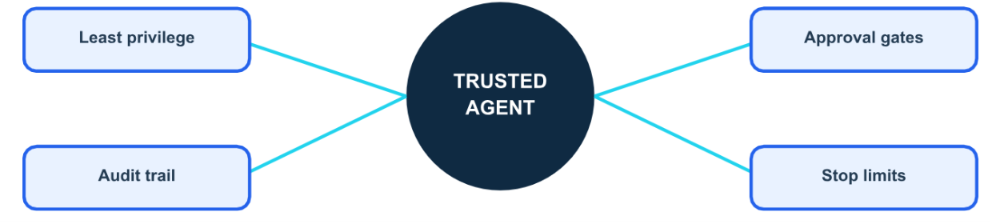
Four controls that matter
Least privilege. Give the agent only the accounts, folders and actions required for the current job. Separate reading, drafting and publishing permissions.
Approval gates. Require confirmation before spending money, sending external messages, deleting records, changing production systems or making commitments.
Audit trail. Record sources, tool calls, important decisions, failures and the final state. A person should be able to reconstruct what happened.
Stop limits. Cap time, cost, retries and the number of affected records. Define what uncertainty should trigger escalation.
A practical readiness checklist
| No. | CHECKLIST |
|---|---|
| 01 | Outcome Can success be stated and tested? |
| 02 | Scope Are allowed data, systems and actions explicit? |
| 03 | Reversibility Can changes be previewed, rolled back or isolated? |
| 04 | Escalation Does the agent know when and whom to ask? |
| 05 | Evidence Will the morning report show sources and exceptions? |
Start with one quiet, measurable win
The best first agent is not the one with the widest mandate. It is the one attached to a repetitive, observable workflow where mistakes are contained and results are easy to compare.
Choose a task with a stable input, a clear definition of done and a reviewable output. Begin in read-only or draft mode. Run the agent beside the existing process for several cycles, measuring completion rate, corrections, false alarms, time saved and cost per successful job. Expand permissions only after the evidence supports it.
A useful first-night brief
Goal: Review new support conversations received after 6 p.m. Group them by issue, identify urgent cases and prepare reply drafts using the approved knowledge base.
Boundaries: Do not send messages, issue credits, open unknown links or access records outside the support workspace. Stop after 100 conversations or 45 minutes.
Morning output: A summary of volume and themes; an urgent queue with reasons; drafts with citations; and a list of cases that need human judgment.
What changes when work becomes asynchronous?
Managers begin designing outcomes and guardrails instead of assigning every step. Teams review exception queues instead of processing every routine item. Software becomes less like a passive tool and more like a junior operator: fast, tireless and useful, but still in need of supervision and accountability.
The organizations that benefit most will not be those that remove people from the loop. They will be those that place people at the most valuable points in the loop - setting intent, resolving ambiguity, approving consequential actions and learning from the evidence agents produce.
By morning, the ideal agent has not merely been busy. It has made progress that is visible, verifiable and safe to use.
Get in Touch
Looking to build a scalable application for your growing business?
Talk to Our Experts | Get a Free Consultation
🌐 Website: Tecneural Software Solutions
📧 Email: support@tecneural.com
📞 Contact: +91 96555 17034