
 Crewmate
 DeepAgent
 MemeMint
 Safenest
 Tapvault
 Bitvm
Bitvm
How Bitcoin Mempools Are Being Rebuilt: Cluster Mempool and Package Relay
Bitcoin is not changing its fixed supply or proof of work to improve transaction handling. Instead, developers are redesigning how nodes reason about unconfirmed transactions before they enter a block. Cluster mempool and package relay address the same underlying problem: transactions often depend on one another, but the network has historically relayed and managed them with rules that can treat them too independently.
The Mempool Is Local
A mempool is a node's local waiting area for valid, unconfirmed transactions. There is no single global mempool. Each node decides what to keep and relay using its own resource limits and policy settings. Nodes try to converge on similar contents because that improves fee estimation, compact block relay and predictability, but temporary differences are normal.
Why Dependencies Matter
A child transaction can spend an output created by an unconfirmed parent. The child is invalid without the parent, so miners must place the parent earlier in the block. This relationship also enables child pays for parent (CPFP): a high-fee child can raise the economic value of mining a low-fee parent and child together.
The difficulty appears when a receiving node rejects the low-fee parent before it sees the child. The child then looks like an orphan because its input is missing. Evaluating either transaction alone hides the value of the pair. Package-aware processing restores the missing context.
Two Connected Upgrades
- Package relay: Answers how related transactions should move between peers. It carries dependency context across the P2P network.
- Cluster mempool: Answers how a node should organize and compare related transactions. It creates a bounded model for ordering, eviction and replacement.
How Package Relay Works
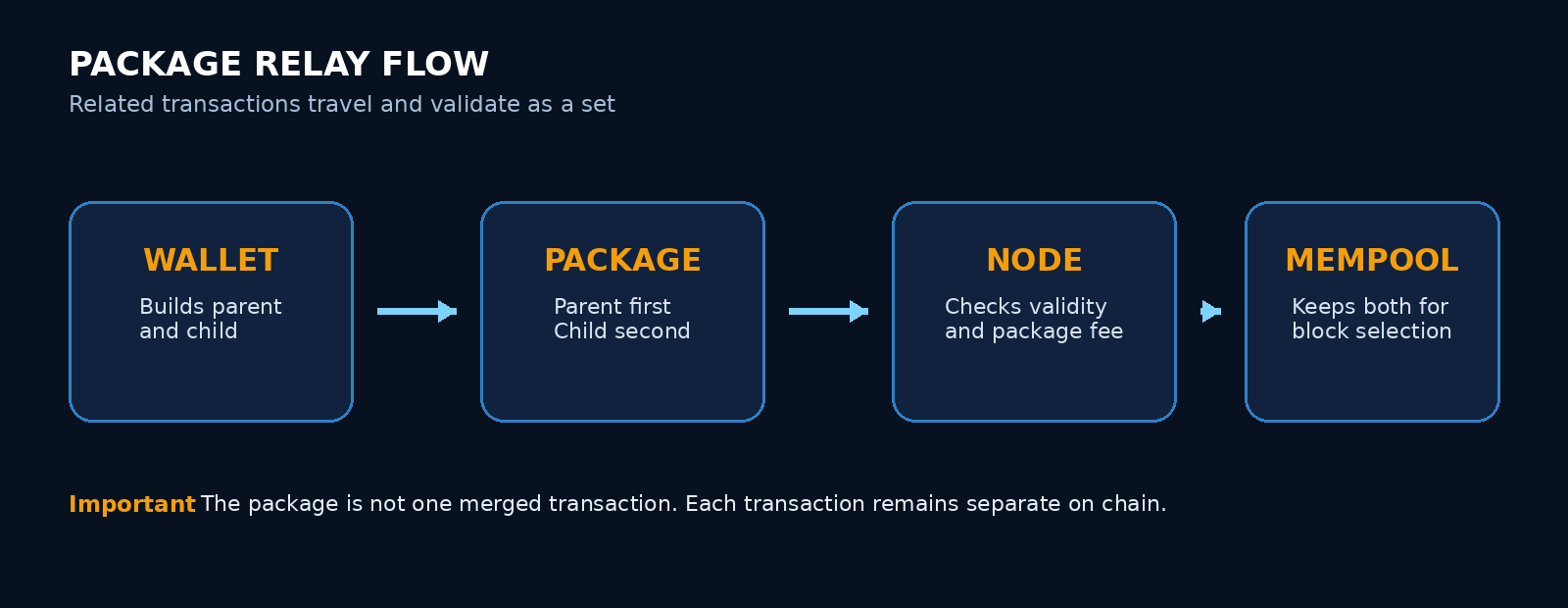
Package relay lets peers exchange related unconfirmed transactions with enough context to evaluate them together. A package is not a new on-chain object, and its transactions are not merged. Each transaction keeps its own identifier, inputs, outputs and position in a valid dependency order.
A Parent and Child Example
Suppose a parent pays a fee below a node's current mempool minimum. A child spends the parent's output and pays a much higher fee. Individually, the parent may be unattractive. Together, their combined fee rate may justify the block space consumed by both. Package validation checks consensus rules for every transaction, dependency order, conflicts and the applicable mempool policies before accepting the set.
- The parent must be available before the child can be fully validated.
- The package fee rate considers total fees relative to the total virtual size of the related transactions.
- Miners still include separate transactions in dependency order; the package itself is not written to the blockchain.
Local Submission Is Not Network Relay
Bitcoin Core's submitpackage RPC can submit raw transactions to one local node for package-aware validation. That capability does not by itself guarantee network-wide propagation. A P2P relay protocol is needed so peers can discover missing ancestors and exchange the relevant set safely. BIP 331 specifies draft peer messages for ancestor package relay and uses a receiver-initiated flow: a node that receives a child can request information and transactions needed to resolve its ancestors.
This distinction matters for wallet developers. A successful local result proves that one node accepted the package under its current policies. It does not prove that every peer has the same mempool state, supports the same relay behavior or will forward the package. Production wallets still need clear rebroadcast, monitoring and fee-management strategies.
How Cluster Mempool Changes Node Reasoning
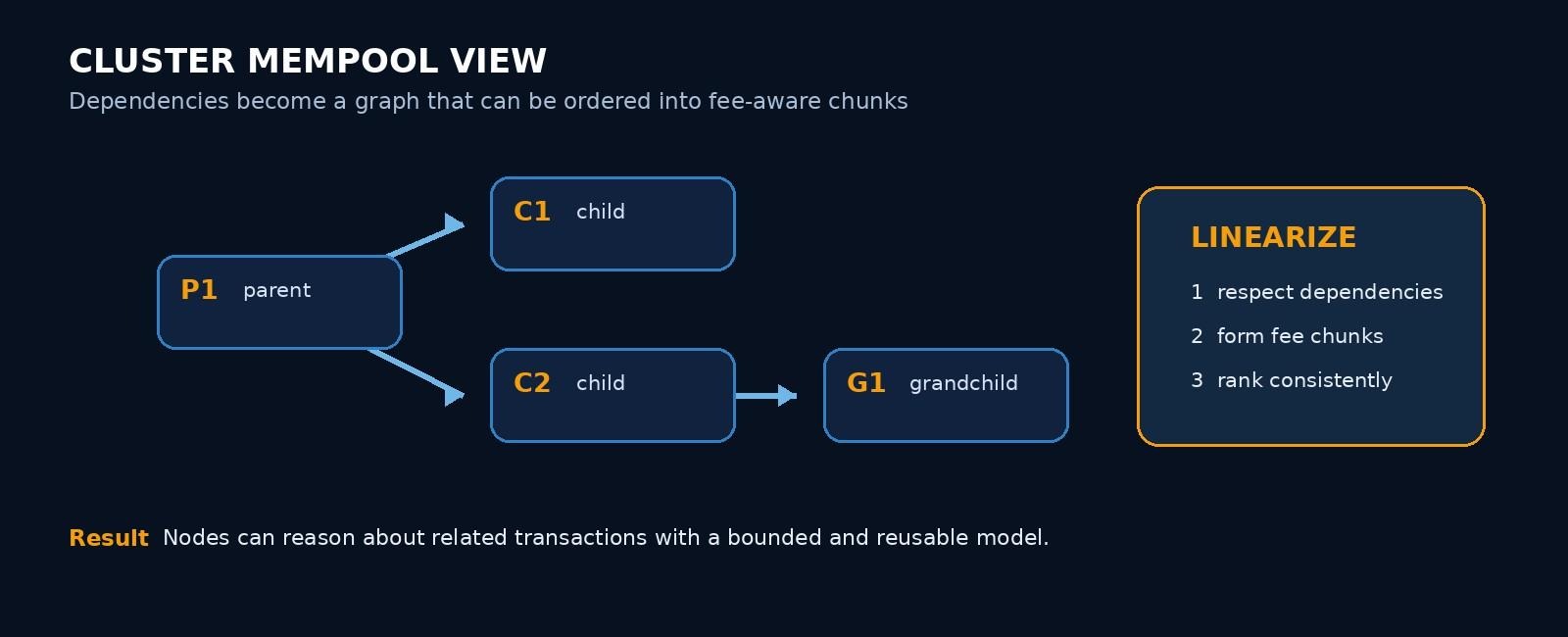
Package relay solves transport; cluster mempool addresses internal organization. It groups transactions connected through unconfirmed dependencies into clusters. A cluster can then be linearized: the node calculates an ordering that respects every parent-before-child requirement while exposing economically meaningful groups called chunks.
From Ancestor Scores to Bounded Clusters
Today's policy must repeatedly answer questions such as which transactions a miner would choose, which entries should be evicted when memory is full and whether a replacement improves the mempool.
Dependencies make those calculations difficult because changing one transaction can affect several descendants. Cluster mempool aims to constrain the size and shape of the problem so nodes can use a consistent linearization rather than recomputing large dependency sets in ad hoc ways.
A chunk may contain one transaction or several transactions whose fees and sizes are best evaluated together. Its chunk fee rate becomes a reusable score for block building and other policy decisions. The design goal is not to change which transactions are valid under Bitcoin consensus. It is to make local policy faster, safer and easier to reason about.
What the Redesign Can Improve
- Block construction can compare economically meaningful chunks while preserving transaction dependencies.
- Eviction can avoid removing a transaction whose descendants make the overall cluster valuable.
- Replacement rules can evaluate whether a proposed set improves the mempool instead of comparing isolated transactions.
- Package relay and fee estimation can reuse the same model of how related transactions compete for block space.
What Does Not Change
Cluster mempool is node policy work, not a new asset, token or consensus layer. Blocks still contain ordinary Bitcoin transactions. Full nodes still validate each transaction and block against consensus rules. The redesign concerns the temporary, local state that exists before confirmation.
Why This Matters Beyond the Mempool
More reliable handling of transaction packages matters most when spending conditions are time-sensitive. Lightning channel protocols, vault designs and other contract systems may need to publish a transaction and raise its fee after broadcast. If the fee-bumping child cannot propagate because peers rejected or forgot the parent, the user has less confidence that miners will see the intended package. Better package handling narrows that gap.
Benefits for the Bitcoin Ecosystem
- Wallets gain a clearer path for CPFP fee bumping during congestion.
- Lightning implementations gain more dependable tools for urgent on-chain transactions.
- Node operators gain policy that is easier to bound against denial-of-service pressure.
- Miners and relay nodes can reason from a more consistent model of transaction value.
Limits and Open Work
These improvements are incremental and policy-sensitive. BIP 331 remains a draft specification, implementations must defend every new request and validation path against resource exhaustion, and older peers must remain interoperable. Package support will also arrive unevenly across nodes, wallets and services. Developers should therefore distinguish implemented local package acceptance from deployed P2P package relay.
Cluster mempool is likewise an engineering program rather than a single switch. Linearization algorithms, cost models and integration points continue to evolve. The practical test is whether the design makes block building, eviction, replacement, relay and fee estimation more predictable without weakening validation or exposing nodes to unbounded work.
The Larger Direction
Bitcoin scaling is often described in transactions per second, but reliability depends just as much on how nodes handle transactions before confirmation. Package relay gives dependent transactions a way to travel with their context. Cluster mempool gives each node a disciplined way to evaluate that context. Together, they move the mempool toward a model that better matches how modern wallets and contract protocols actually use Bitcoin.
Sources
- Bitcoin Optech — Cluster Mempool
- Bitcoin Optech — Package Relay
- BIP 331: Ancestor Package Relay
- Bitcoin Core — submitpackage RPC
Contact Tecneural Software Solutions
- 🌐 Website: Tecneural Software Solutions
- 📧 Email: support@tecneural.com
- 📞 Contact: +91 96555 17034