
 Crewmate
 DeepAgent
 MemeMint
 Safenest
 Tapvault
 Bitvm
BitvmDeepAgent
Tecneural: Top Rated Software Development Services Company for 2026
DeepAgent Autonomous
DevOps Engineer
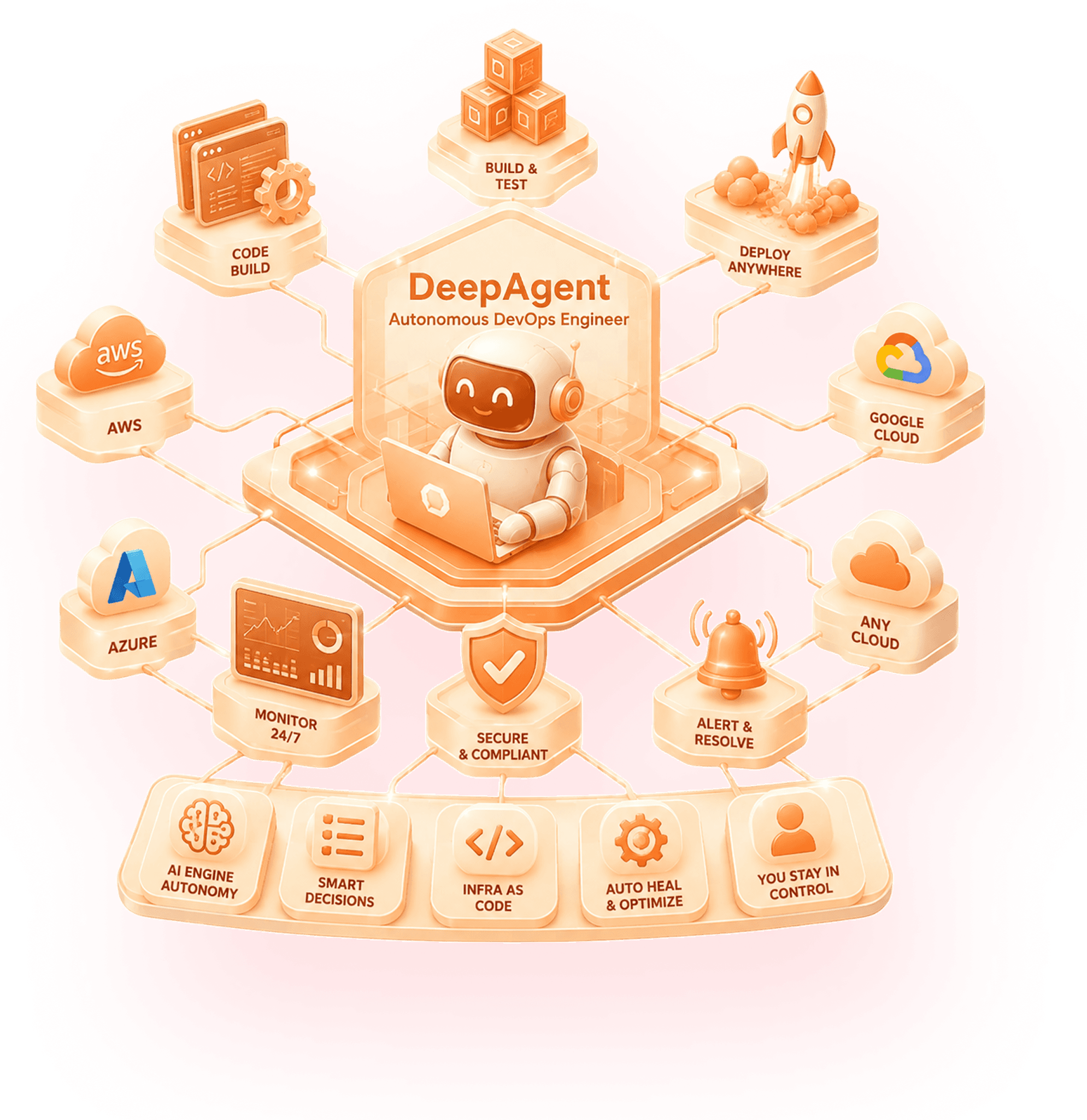
An AI engineer that builds, ships, and watches your software around the clock on AWS, Google Cloud, Azure, or any cloud you choose. It handles the heavy lifting and the late-night problems. You keep every important decision
OVERVIEW
An AI Engineer That Runs Itself
DeepAgent is TecNeural's autonomous DevOps engineer an AI system that builds, ships, and watches over your software around the clock, combining the judgment of a senior engineer with the availability no human team can sustain
Most tools stop the moment code goes live. DeepAgent doesn't. It carries the pipeline from a committed idea all the way through build, test, deployment, and into continuous operation watching every service, catching problems before customers do, and reversing bad changes automatically. It runs on whichever cloud you already use, or across several at once, and it never ships anything risky without asking first
This portfolio walks through DeepAgent's delivery pipeline, the safeguards that keep it accountable, its cloud and monitoring coverage, and the division of labor between the agent and your team closing with the business case for putting it to work
Positioning
DeepAgent is built as infrastructure, not a black box. Its feature set centers on delivery, monitoring, and recovery designed to sit alongside a lean team rather than replace human judgment on anything that matters

Cloud Agnostic
Runs on AWS, Google Cloud, Azure, DigitalOcean, or a mix of providers, without rewrites

Human in the Loop
Risky or high impact changes always wait for a one click human approval

Always Watching
Every service not just the critical ones is monitored continuously, 24/7

Self Healing
A misbehaving change is rolled back automatically, in seconds, without a scramble
Delivery Pipeline
From Code to Recovery Automatically
Every change moves through a controlled pipeline built, tested, approved, deployed, monitored, and automatically recovered if something goes wrong.

Code
Starts from your idea or commit the trigger for everything that follows

Build
Packages the application into a deployable artifact, consistently and reproducibly

Test
Runs automated checks, including security scanning, before anything moves further

Deploy
Ships the change but only once a human has approved it (see Section 03)

Monitor
Watches every service in production continuously, not on a periodic schedule

Alert
Flags issues the moment they appear before customers notice them

Rollback
Auto recovers by reverting to the last known good version if something misbehaves
How they connects
Code becomes a Build, a Build is verified in Test, a tested artifact reaches Deploy only after approval, and from there Monitor, Alert, and Rollback keep watch indefinitely. Remove the human checkpoint at Deploy and the loop still runs just without your say. Remove Monitor and the agent loses the eyes it needs to Alert or Rollback anything at all
Core Capabilities
Powerful, Never Reckless
Automation is only useful if you can trust it. DeepAgent is built with a safety net so it can move fast without ever putting your business at risk. You stay in control, three ways

Approvals
Nothing risky goes live without your yes. DeepAgent shows the plan, the cost, and the impact of a change you approve or reject it in one click before it ever reaches production

Alarms
It catches problems early a slow service, a cost spike, a security risk and tells you before customers ever notice, rather than waiting for a postmortem

Rollback
If a change misbehaves, DeepAgent reverses it in seconds, automatically returning to the last version that worked. No scramble, no downtime, no waiting for someone to wake up
Why it matters
Each of the three safeguards covers a different failure mode: Approvals stop a bad change before it ships, Alarms catch problems Approvals couldn't anticipate, and Rollback is the last line of defense if both are bypassed by something unexpected
The Gap IT Closes
Getting Software Live Is the Easy Half
Most automation tools take your code and ship it then they stop. From that moment on, keeping everything running smoothly falls on people: watching dashboards, spotting trouble at 3am, stopping a bad release, bringing the system back when something breaks. That work is expensive, hard to staff, and impossible to do every minute of every day. DeepAgent closes that gap it carries the pipeline past launch into continuous, around the clock operation
| Without DeepAgent The Team Carries It | With DeepAgent The Agent Carries It |
|---|---|
| Needs senior DevOps engineers rare and costly to hire | The AI does the routine engineering work; no large team required |
| Problems are found by customers before your team notices | Watches every service and catches trouble before customers do |
| A bad release means a frantic, manual rollback under pressure | If a change misbehaves, it rolls back automatically in seconds |
| Nights and weekends still need someone on call | Works 24/7 the 3am page goes to the agent first |
Any Cloud, No Lock-In
Your Cloud. Your Choice
DeepAgent isn't tied to one provider. Run on Amazon, Google, Microsoft, or a smaller cloud or spread your systems across several at once. You decide where your software lives; DeepAgent speaks all of them. No rewrites, no being trapped with a single vendor
| Provider | Coverage |
|---|---|
| Amazon Web Services | EKS · EC2 · RDS · S3 |
| Google Cloud | GKE · Compute Engine · Cloud SQL |
| Microsoft Azure | AKS · Virtual Machines · Azure SQL |
| DigitalOcean & more | Managed Kubernetes and beyond |
How it stays safe
Multi-cloud coverage doesn't relax the safety model Approvals, Alarms, and Rollback apply identically regardless of which provider a given service runs on, so moving or splitting workloads across clouds doesn't create a gap in oversight
Nothing Slips Through
Every Service, Watched Not Just the Big Ones
Your app is really dozens of small parts working together the login, the payments, the database, the search, the tiny background job nobody remembers. Through Kubernetes, DeepAgent keeps a constant eye on each and every one of them. If any single part slows down or stops, it knows first and acts before it becomes an outage
| Service | What's Watched |
|---|---|
| Login & accounts | Sign-in and user sessions, checked continuously for slowdowns |
| Payments | Every transaction path monitored so revenue never quietly stops |
| Databases | Storage, backups, and capacity tracked around the clock |
| Background jobs | The quiet tasks emails, reports, cleanups never forgotten |
Who Does What
The Agent Does the Work. You Make the Calls
A simple rule: DeepAgent handles roughly 80% of the labor. You keep the 20% that matters the decisions
The Agent Handles the Work
Create & Launch Meme Coins
Fixes routine problems
Catches cost and security issues
Watches every service, 24/7
Rolls back bad changes
Handles the 3am pages
You Keep the Decisions
Approve risky or high impact changes
Set the direction and priorities
Make the judgment calls
Why the split holds
The 80% the agent owns is repeatable, well defined engineering labor exactly the kind of work automation handles reliably. The 20% it doesn't touch is judgment that depends on business context DeepAgent isn't positioned to have, which is why Approvals (Section 03) route those decisions back to you
Built For Teams Like Yours
Where DeepAgent Earns Its Keep
From intuitive coin launches to advanced analytics, the app delivers tools to build, track, and scale a meme coin ecosystem end to end

Startups with no DevOps hire
Ship like you have a full operations team without the salaries or the wait

Fast growing teams
Scale across clouds and regions without your engineers drowning in infrastructure work

Products that must stay up
24/7 watching and instant rollback keep customer facing apps reliably online

Teams tired of 3am calls
The agent takes the first response to incidents, so people aren't woken for routine issues

Multi-cloud and migrations
Moving between providers or running on several? DeepAgent works the same everywhere

Cost conscious businesses
Catch wasteful spend and runaway cloud bills early, before they hit the invoice
What You Get
The Business Case, in Plain Terms
| Benefit | What It Means |
|---|---|
| Spend less | Run lean without a large operations team, and catch cloud waste before it adds up |
| Stay online | Constant monitoring plus instant rollback means fewer outages and happier customers |
| No lock in | Your cloud, your choice switch or combine providers without starting over |
| Stay in control | Approvals on risky moves and a full record of every action nothing happens in the dark |
| Sleep better | The agent takes the night shift; your team focuses on building, not babysitting |
Feature Summary
At a Glance
A complete summary of DeepAgent's pipeline, safety, cloud, and monitoring capabilities covered in this portfolio
| Feature | Category | Summary |
|---|---|---|
| Code → Build → Test | Pipeline | Packages and verifies every change before it can ship |
| Approval-Gated Deploy | Safety | Nothing risky ships without a one click human yes |
| Continuous Monitoring | Operations | Every service watched 24/7, not on a schedule |
| Alarms | Safety | Flags slowdowns, cost spikes, and security risks early |
| Automatic Rollback | Safety | Reverts a misbehaving change in seconds |
| Multi-Cloud Support | Infrastructure | Runs on AWS, GCP, Azure, DigitalOcean, or a mix |
| Kubernetes Native Coverage | Operations | Tracks every microservice, not just the critical few |
| 80/20 Human Agent Split | Governance | Agent handles routine labor; you keep the decisions |
| Cost Monitoring | Operations | Surfaces wasteful spend before it hits the invoice |
| Full Action Record | Governance | Every change and rollback is logged and reviewable |
Note on independent verification
This portfolio describes DeepAgent's stated feature set for presentation purposes. Stakeholders evaluating the product for production use should confirm current monitoring coverage, approval workflows, and rollback behavior against their own environment before relying on it for critical workloads