
 Crewmate
 DeepAgent
 MemeMint
 Safenest
 Tapvault
 Bitvm
Bitvm
Bitcoin Escrow Is Broken. Here's How Taproot MAST Fixes It in 2026
A free, non-custodial Bitcoin escrow platform built on Taproot multisig — and why we open-sourced it.
Every month, somewhere on Reddit or Telegram, someone gets scammed in a peer-to-peer Bitcoin trade. The pattern is always the same. Buyer sends fiat. Seller disappears. There is no recourse, no chargeback, no support ticket. The money is gone.
The fix has been obvious for over a decade — escrow. But almost every Bitcoin escrow service that exists today is custodial. The platform holds your coins. You are trusting them not to run, not to get hacked, and not to freeze your funds when you need them. That is not escrow. That is just a different kind of counterparty risk.
This post is about the alternative — trustless, non-custodial Bitcoin escrow — what it actually means at the protocol level, why it is finally easy to build in 2026, and where you can get a production-ready implementation for free.
What "trustless" actually means here
Let us get the definition right, because the term gets thrown around loosely.
A trustless escrow means the platform operator cannot move user funds unilaterally. Funds are locked in a Bitcoin script that requires multiple parties to agree before anything moves. The platform is a coordinator and arbitrator — not a custodian.
Concretely, a trustless escrow has three properties:
- 1. No platform-controlled wallet holds user funds. Coins sit in a Taproot output that the platform alone cannot spend.
- 2. Release requires buyer and seller cooperation for the happy path. No platform signature needed.
- 3. Disputes fall back to a 2-of-3 arbitration, where the platform is the third signer — but only one of three. And if the platform itself disappears, a CSV timelock returns funds to the buyer automatically.
If any of those four properties are missing, it is not trustless. It is just escrow with extra steps.
The architecture in one diagram
Here is the entire flow, end to end:
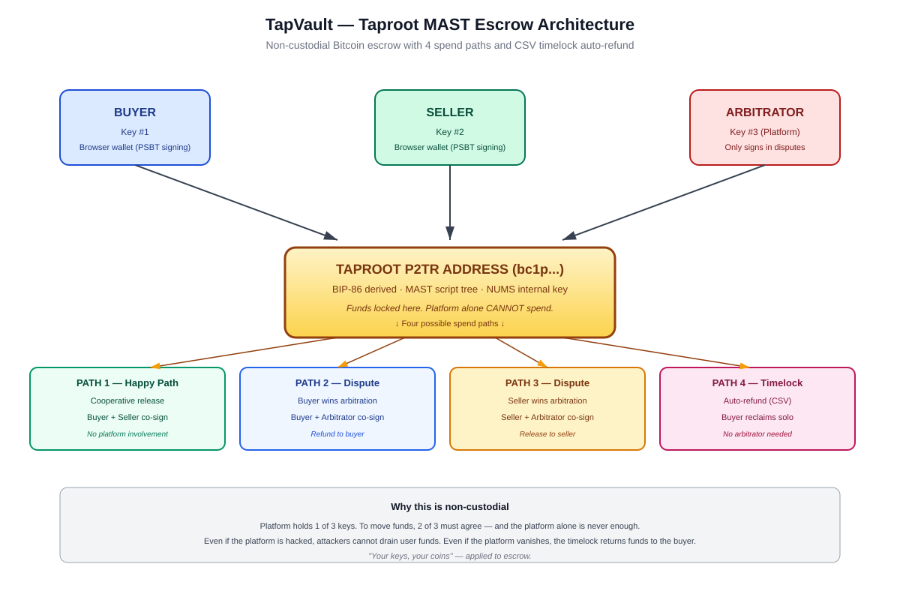
Three keys. One on-chain output. Four spend paths. The platform holds one of three keys, and only ever uses it during a dispute. In normal operation — which is most of the time — the platform never signs anything. And if it ever vanishes, the timelock path returns funds to the buyer with no platform involvement at all.
This is the design pattern Bitcoin has been quietly capable of since 2013 with P2SH multisig, and elegantly capable of since Taproot activated in 2021. With BIP-86 Taproot key derivation, MAST script trees, and Schnorr signatures, the entire system fits in a few hundred lines of TypeScript.
Custodial vs. non-custodial — at a glance
If you only remember one table from this article, make it this one:
| Property | Custodial Escrow | TapVault (Non-Custodial) |
|---|---|---|
| Who holds the funds? | Platform | On-chain Taproot script |
| Can platform run away? | Yes | No — platform has 1 of 3 keys |
| If platform gets hacked? | Funds drained | Funds safe on-chain |
| If platform vanishes? | Funds lost | Timelock auto-refunds buyer |
| KYC required? | Usually yes | No |
| Privacy on-chain? | Distinguishable multisig | Looks like a normal payment |
Why this is suddenly a 2026 product, not a 2018 one
If you tried to build this five years ago, you would have hit three walls.
Wall 1 — Multisig was expensive
Pre-Taproot multisig outputs were large, distinguishable on-chain (everyone could see "this is a 2-of-3"), and the fees ate into small trades. A $50 freelance escrow paying $8 in fees does not work.
Wall 2 — Indexing was painful
To know whether a buyer had funded an escrow address, you needed your own Bitcoin node and a block scanner. Trezor's open-source Blockbook indexer changed that — you can now query address balances, UTXOs, and confirmation status over a clean HTTP API.
Wall 3 — User-side signing was a nightmare
Asking a non-technical buyer to manually construct a PSBT in 2019 was a non-starter. Today, Xverse, Leather, OKX, and most modern Bitcoin wallets sign PSBTs natively from a web prompt — same UX as MetaMask on Ethereum.
All three walls are gone. Taproot makes multisig look like a single-sig spend on-chain (cheaper, more private). MAST hides the unused spend paths. Blockbook handles indexing. Browser wallets handle signing. The remaining work is pure application logic — and that is the part we open-sourced.
The five things a production escrow platform actually has to handle
Theory is easy. Production is where most attempts die. Here is the real list:
- 1. Address derivation that is deterministic and recoverable
Each escrow needs its own address. You do not want all funds going to one shared address — that is a privacy disaster and a single point of failure. BIP-86 Taproot derivation lets you mint a fresh address per escrow from a single arbitrator seed. If your database ever burns down, you can re-derive every address from the seed and recover state from chain history.
- 2. PSBT construction with sane fee estimation
The release transaction is a PSBT (Partially Signed Bitcoin Transaction) that the platform builds, the participants sign, and someone broadcasts. Fee estimation has to be live — using mempool.space or Blockbook fee endpoints — because a stale fee means the transaction sits unconfirmed for hours and your support inbox lights up.
- 3. Deposit detection without rate-limit pain
You need to know the moment a buyer's deposit hits the mempool, then again at 1, 3, and 6 confirmations. Naive solution: poll every address every 30 seconds. Real solution: WebSocket subscriptions on Blockbook for active escrows only, and a back-off polling tier for older ones.
- 4. Dispute workflow with audit trail
When a dispute opens, both parties submit evidence. The arbitrator reviews, decides, and signs the PSBT alongside the winning party. Every step needs to be timestamped and immutable for legal reasons — you want a defensible record if a participant later claims the arbitration was rigged.
- 5. Subscription billing that does not conflict with the trustless model
This is the subtle one. You can charge users a SaaS fee (monthly subscription, per-escrow flat fee) without ever touching their Bitcoin. Stripe handles the fiat side completely separately from the on-chain flow. Your revenue is independent of trade volume — which means you do not have a regulatory "money transmitter" problem in most jurisdictions. (Not legal advice. Talk to a lawyer for your specific case.)
Meet TapVault — the open implementation
TapVault is the production-grade implementation of exactly this architecture. It ships with all five concerns above already solved, and it is free.
- Taproot MAST escrow with four spend paths — cooperative release, two dispute paths, and CSV timelock auto-refund
- Unspendable internal key (NUMS point) so all spends go through script paths — no key-path bypass
- Six escrow templates out of the box — Quick Trade, Freelance with milestones, Digital Product, Physical Product, Rent / Deposit, and Custom
- Browser-side signing with AES-256 encrypted keys — keys never leave the user's device
- Blockbook indexer integration for deposit detection and confirmations
- Stripe billing wired up out of the box (Free, Pro, Enterprise tiers — your subscription, your revenue)
- Mainnet, testnet, and regtest support — develop locally, switch with one environment variable
- Admin dashboard with revenue analytics, user management, dispute resolution, and refund tracking
- NextAuth v5 with 2FA, role-based access, and Mailjet transactional emails
- Self-hosted, white-label, no KYC — you own the platform
Stack: Next.js 16, React 19, TypeScript, Tailwind v4, DaisyUI, MongoDB + Mongoose, bitcoinjs-lib, Schnorr signatures, BIP-86 Taproot.
Who is Tecneural — and why we gave this away
Tecneural is a Bitcoin Layer-2 and AI infrastructure team. We build two things:
- Bitcoin L2 infrastructure using BitVM — with cross-chain bridges into the Cosmos and EVM ecosystems. We design validator coordination, two-way pegs, threshold signature schemes, and the consensus-aware tooling around them.
- Custom AI model builder for industries that need their own domain models — finance, healthcare, legal, supply chain, and others. We help teams go from raw data to a deployed model that actually fits their workflow.
Practice
| Practice | What we build |
|---|---|
| Bitcoin Layer-2 | BitVM-based L2 infrastructure connecting Bitcoin with Cosmos and EVM ecosystems. Trust-minimized bridges, validator coordination, threshold signature schemes. |
| Cross-Chain Interop | BitVM bridges, two-way pegs, and SPV verification systems. Move BTC across Cosmos zones and EVM chains without giving up sovereignty. |
| AI Model Builder | Domain-specific AI models for finance, healthcare, legal, supply chain, and other industries. Training pipelines, fine-tuning workflows, and on-prem deployment. |
| Open Bitcoin Tooling | TapVault is one of several open releases. We publish what we build because the Bitcoin commons benefits — and because trust is earned by showing the work. |
So why give away a polished Bitcoin escrow platform for free?
Two reasons. First, the Bitcoin ecosystem benefits when good non-custodial primitives are easy to access. The status quo of "trust this random custodian with your coins" is bad for users and bad for the network. Releasing TapVault openly is one small way of fixing that.
Second, building TapVault publicly is how we show what we are capable of. The same team that designs BitVM bridges, Schnorr signature aggregation, and threshold signing systems for Bitcoin L2s wrote this escrow. If you are evaluating partners for a hard Bitcoin or AI infrastructure project, TapVault is the proof point — clean architecture, production-ready code, real cryptographic care.
Free open infrastructure plus paid expertise is the model behind Linux, Postgres, and most of the libraries you depend on. It works because the open part earns trust faster than any sales deck ever could.
Who this is for
Crypto entrepreneurs
You want to launch a Bitcoin-native marketplace, P2P trading platform, or freelance hub and you do not want to spend six months on the cryptographic backend. Configure templates, brand the UI, set your subscription pricing, deploy. Live in a weekend.
Web3 development agencies
You get client requests for "Bitcoin escrow" and currently have to either turn them away or quote a six-figure custom build. TapVault gives you a base to white-label and customize per client. We are also happy to support you on deployment or custom features.
Developers learning Bitcoin scripting
You want a real, working production codebase to study. The PSBT construction, Taproot derivation, MAST script tree, and dispute resolution code is all readable, commented TypeScript. It is a better teacher than any tutorial because it has to handle real edge cases — fee bumps, double-spends, reorgs, timelocks.
Teams building larger Bitcoin systems
If you are working on something bigger — an L2, a sidechain bridge, a custody product, a DeFi-on-Bitcoin protocol — the same Tecneural team behind TapVault can help. Reach out.
How to launch on TapVault this week
Day 1 — Stand up TapVault on testnet. Wire your domain, brand the UI, configure the templates you actually need. Cut the ones you do not.
Day 2-3 — Run a closed beta with 10 friendly users on testnet. Watch where they get confused. The deposit confirmation step is usually the friction point.
Day 4-5 — Switch to mainnet, lower your trade limits initially, set up real Stripe live keys, and open signups. Do not over-market yet.
Week 2+ — Customize. Add your own templates (e.g., "domain transfer escrow," "OTC swap," "rental security deposit") on top of the built-in six. The template system is data-driven, so this is config, not code.
The platforms that win in this niche are not the ones with the most cryptographic novelty — they are the ones with the cleanest UX, the best dispute support, and the lowest fees. The cryptography is solved. The product layer is where the differentiation lives.
Closing thought
Bitcoin escrow has been technically possible for 13 years. The reason it has not taken over peer-to-peer trade is not a missing primitive — it is a missing product layer. Taproot, browser PSBT signing, MAST, and Blockbook closed the last technical gaps. What is left is execution.
If you want to be the one executing, TapVault gives you the runway. We open-sourced it because we believe the Bitcoin commons benefits from good infrastructure being free. And if you want help on the harder problems — L2 design, BitVM bridges, custom AI models — that is exactly what Tecneural is here for.
Either way: stop holding customer funds. The future of Bitcoin commerce is non-custodial, and 2026 is when the rest of the market figures that out.
GET TAPVAULT
TapVault is free. Reach out to Tecneural and we'll send you the source code, deployment guide, and a 30-minute setup call.
Live demo: tapvault.tecneural.com
Get the code: Contact Tecneural — we ship the repository to qualified teams
Larger projects: Bitcoin L2, BitVM bridges, custom AI models — also Tecneural
About the author
Jeyakumar S — CEO at Tecneural. 16+ years building Bitcoin Layer-2 infrastructure, threshold signature systems (FROST, Schnorr aggregation), validator coordination, and cross-chain bridge primitives. Specializes in Rust and C++ cryptographic systems and consensus-layer engineering.
Contact Us
- 📞 Phone: +91 96555 17034
- 📧 Email: support@tecneural.com
- 🌐 Website: www.tecneural.com