






The economics, the regulatory simplification, and the deployment playbook for small Bitcoin OTC operations.

 By Admin
 2026-05-06
How Small OTC Desks Are Replacing Custodial Escrow Services with TapVault — and Saving 6 Figures a Year
If you run a small OTC Bitcoin desk — the kind doing $5M to $50M a year across a few hundred trades — you have probably had this thought at 2 a.m.: "What happens to all of this if our escrow provider gets hacked?"
It is not a hypothetical. The history of Bitcoin OTC has been a steady drumbeat of escrow services that started clean, scaled into custody-heavy operations, and then collapsed under their own weight. Customer funds drained. Trades stuck mid-settlement. Operators left to explain to clients why their cash is gone.
In 2026, there is finally a clean alternative — and the math for moving to it is more compelling than most desk operators realize. Here is what that math looks like, and what it means for your operations.
The hidden cost of custodial OTC escrow
Most OTC desks use a custodial escrow service as a matter of course — it is what their counterparties expect, and it solves the trust problem with one phone call. But the actual annual cost is much higher than the per-trade fees on the invoice. Let's lay it out:
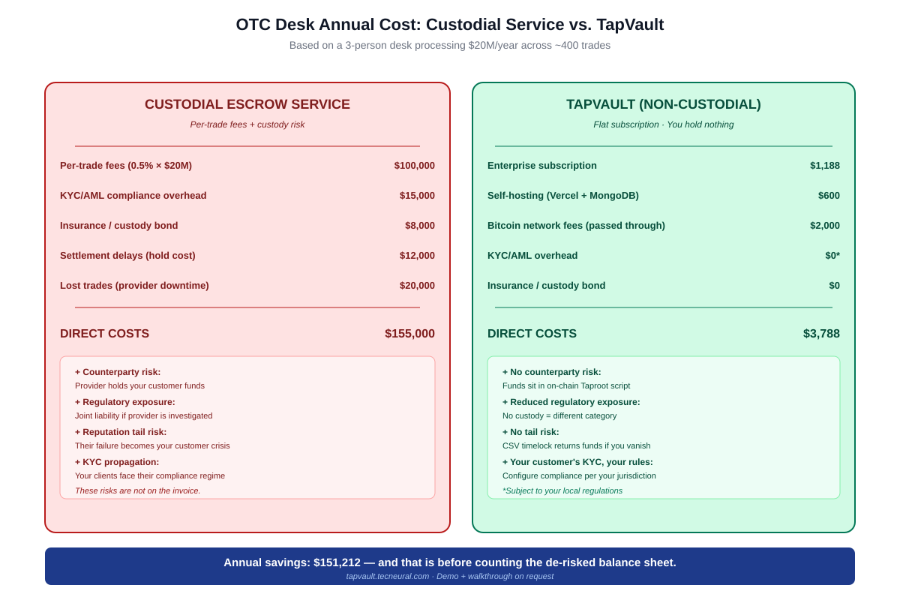
A 3-person OTC desk processing $20M/year is paying roughly $155,000 in direct costs to a custodial provider — half-percent fees on each trade, KYC overhead, custody bond insurance, settlement-delay opportunity costs, and the inevitable 1-2 weeks per year of provider downtime that costs you trades.
The same desk on TapVault pays roughly $3,800 — Enterprise subscription, self-hosting, and Bitcoin network fees passed through to clients. That is a 40x cost reduction on direct costs alone.
But the real story is what is not on the invoice: counterparty risk on the provider, joint regulatory exposure, reputation tail risk if the provider fails, and KYC propagation that imposes the provider's compliance regime on your clients. Most desk operators learn the cost of these only when something goes wrong, which is the worst possible time to learn it.
Why non-custodial design specifically helps OTC
OTC desks have three operational characteristics that make non-custodial escrow unusually well-suited to your workflow:
1. Your trades are bilateral by design
OTC by definition means you know both parties. You are not running an open marketplace where any random user can match with any other. You vet your counterparties, you have direct relationships, and you can coordinate signing in real time. Custodial escrow is overkill for this — it is designed for anonymous strangers. Non-custodial 2-of-3 multisig is exactly right for it.
2. Settlement speed is your competitive moat
In OTC, the difference between settling in 5 minutes and 5 hours is the difference between winning the trade and losing it to a competitor. Custodial providers add 30-60 minute confirmation buffers and human verification steps. TapVault settles as fast as the Bitcoin network confirms — typically 10-30 minutes for high-confidence settlement, instant for cooperative release with both signatures.
For Lightning-eligible trades (under $500K), TapVault's roadmap includes Lightning settlement in seconds, not minutes. That is on Q3 2026, already in active development.
3. You actually want to control the dispute process
In a custodial setup, when a trade goes sideways, the platform's support team adjudicates. They are bound by the platform's rules, their working hours, and their risk appetite. If the platform sides against your counterparty in a way that hurts your relationship, you have no recourse.
On TapVault self-hosted, you can be the arbitrator yourself. You make the call, in your jurisdiction, with your knowledge of the trade history. If you would rather not — Tecneural can arbitrate as the third signer in standard deployments. Either way, the choice is yours, not someone else's.
The regulatory simplification (talk to your lawyer)
This section comes with a heavy caveat: every jurisdiction is different, and you absolutely need to talk to a lawyer for your specific situation. But the general direction is significant enough to mention.
In most jurisdictions, money transmitter licensing applies to entities that take custody of customer funds. A platform that coordinates a trade without ever holding the funds is in a different regulatory category — sometimes substantially lighter.
For a small OTC desk, the difference between holding a state-by-state money transmitter license and operating as a non-custodial coordinator can be the difference between viability and not. We are not telling you to skip your compliance obligations. We are telling you that the compliance obligations themselves may be smaller, because the underlying operation is smaller in regulatory scope.
If you are currently in a state where the cost of MSB-equivalent licensing is a significant fraction of your revenue, the non-custodial pivot is worth a serious conversation with your counsel.
What deployment looks like for an OTC desk
This is not a self-serve weekend deployment for an OTC use case — your operation is too important for that. Tecneural offers deployment partnership for desks specifically:
- Initial 90-minute discovery call to understand your trade volume, counterparty mix, and current pain points
- Custom deployment configuration — typically self-hosted on your infrastructure, configured with your branding and your arbitrator key custody policy
- Integration with your existing CRM, AML monitoring, and reporting tools — TapVault's audit log is API-accessible
- Migration plan from your current provider, including a parallel-running period where new trades go through TapVault while existing custody-tied trades wind down
- Training for your operations team on the new dispute and signing workflow
- Ongoing support — Tecneural handles tier 2/3 issues, your team handles tier 1 customer support
Typical timeline from kickoff to first live trade is 2-3 weeks. Most of that is migration planning, not technical work — the technical setup itself takes a few days.
Three OTC use cases TapVault handles particularly well
Large bilateral trades ($100K - $5M)
This is the sweet spot. Both sides know each other, both want fast settlement, both want clean separation from any third-party custody. TapVault's Quick Trade template handles this in 60 seconds of setup and settles in one Bitcoin confirmation.
Recurring counterparty relationships
If you have one or two anchor counterparties who do regular volume with you, you can set up a permanent template configured for that relationship — fixed limits, pre-approved release patterns, dispute terms baked in. New trades against an established template take 30 seconds to spin up.
Multi-signature corporate accounts
For desks where multiple authorized signers need to approve a trade — typically required by your treasury policy — TapVault supports configurable signer lists per template. You can require 2-of-3 internal signatures combined with the counterparty signature, all enforced cryptographically rather than procedurally.
What to do this week if you're interested
Three concrete next steps, in order of friction:
- 1. Watch the demo flow at tapvault.tecneural.com — about 10 minutes of clicking through. You will get a feel for the UX and the basic mental model.
- 2. Request a 30-minute walkthrough call with Tecneural where we will run through your specific trade workflow and answer the operational questions the demo does not cover.
- 3. If the conversation goes well, we run a small pilot — typically one of your low-stakes trade types for a 30-day period — before committing to full migration. No production risk.
OTC is a relationships business. Getting your escrow rails right is upstream of every relationship you will have for the next decade. Worth doing carefully — and worth doing now, before the next custodial service makes the news for the wrong reasons.
GET TAPVAULT — IT'S FREE
TapVault is open and free. Reach out to Tecneural and we will send you the source code, deployment guide, and a 30-minute setup call.
Live demo: tapvault.tecneural.com
Get the code: Contact Tecneural — we ship the repository to qualified teams
Larger projects: Bitcoin L2, BitVM bridges, custom AI models — also Tecneural
About the author
Jeyakumar S — CEO at Tecneural. 16+ years building Bitcoin Layer-2 infrastructure, threshold signature systems (FROST, Schnorr aggregation), validator coordination, and cross-chain bridge primitives. Specializes in Rust and C++ cryptographic systems and consensus-layer engineering.
Contact Us
- 📞 Phone: +91 96555 17034
- 📧 Email: support@tecneural.com
- 🌐 Website: www.tecneural.com