





The open-infrastructure flywheel, why trust is the new unit of business, and how Tecneural is built around it.

 By Admin
 2026-04-30
Why I Gave Away My Bitcoin Escrow SaaS Code for Free — and What That Says About Where Crypto Is Going
Last month I shipped a non-custodial Bitcoin escrow SaaS. Polished UI, six escrow templates, Stripe billing already wired up, mainnet-ready. The kind of thing freelance developers quote $40,000 to $100,000 to build.
I gave it away for free.
People keep asking me why. The answer is longer than a tweet, but it is worth getting right — because I think the model behind it is where a lot of crypto, AI, and infrastructure businesses are heading, whether they realize it yet or not.
So this post is the explanation. Not as a pitch, but as a thesis on how trust works in 2026, why selling code is becoming the wrong unit of business, and what that means for anyone building in deep technical fields.
First — what I actually gave away
TapVault is a self-hosted, non-custodial Bitcoin escrow platform. Two parties can lock Bitcoin in a 2-of-3 Taproot multisig, agree to release it cooperatively, fall back to arbitration if they disagree, or recover funds via a CSV timelock if the platform itself disappears.
It runs on Next.js 16 and MongoDB. It ships with six escrow templates (P2P trade, freelance, digital products, physical goods, rentals, custom), Stripe-based subscription billing, browser-side key encryption, an admin dashboard, and full mainnet/testnet/regtest support.
In the custodial world this would be a Series-A startup. In the open-source world it is a GitHub repository. Same code. Different distribution model. Wildly different economics.
The flywheel — how giving away the artifact creates the business
Here is the model in one diagram:
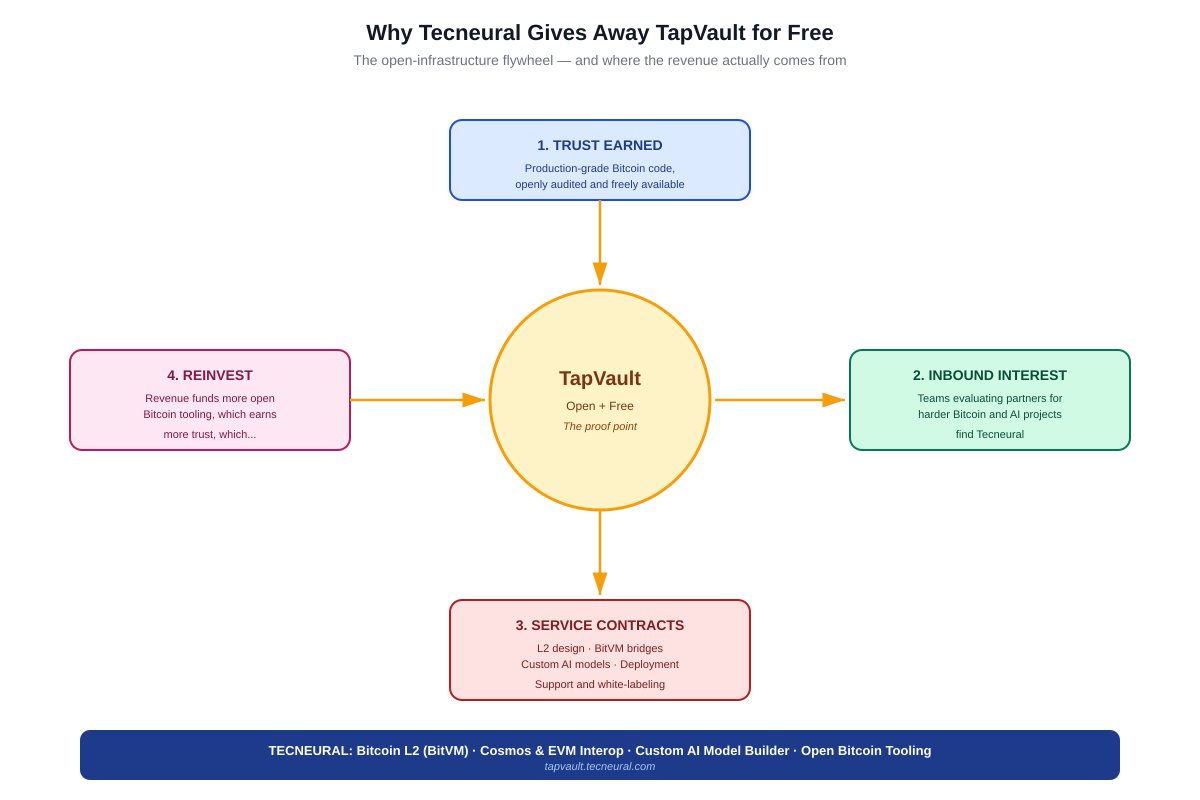
Free, well-built infrastructure earns trust faster than any sales process. Trust attracts inbound interest from teams working on adjacent — and harder — problems. That interest converts into service contracts, support contracts, and partnership deals. The revenue from those funds more open infrastructure. The flywheel keeps spinning.
This is not a new model. Linux, PostgreSQL, Redis, Stripe's open libraries, every cloud provider's open-source tooling — they all run on this loop. The difference is that the model is now reaching deeper into vertical-specific software. Things that used to be sold as proprietary scripts are becoming free, with the value migrating to expertise around them.
Why this works specifically for deep technical work
Three reasons the open-infrastructure model is particularly well suited to crypto and AI:
1. The hard problems are not the visible artifacts
Building a Bitcoin escrow platform is hard. But it is finite. Once you ship it, the hard work is done — what remains is integration, support, customization, scaling. Those are services, not products.
The same applies to AI. Building a model that classifies invoices is finite work. Building the data pipelines, evaluation harnesses, retraining systems, and deployment infrastructure that keep it accurate over five years — that is ongoing service work.
So the artifact (the script, the model checkpoint) is the entry point. The retainer is the business.
2. Trust is the actual product
If you are a CTO evaluating who to hire for your Bitcoin Layer-2 project, you do not buy from the team with the slickest sales deck. You buy from the team whose code you can read, run, and verify.
Open-source artifacts are evidence in a way that closed code can never be. They let prospective clients pre-validate the team before any commercial conversation starts. By the time someone reaches out about a Tecneural service contract, they have usually already deployed TapVault, read the source, and decided we know what we are doing.
The first sales conversation, in this model, is not a sales conversation. It is a scoping conversation. The trust step happened before the email.
3. The market for high-end services is small but high-value
If TapVault sold for $59 on CodeCanyon, the math would be: 1,000 sales = $59,000. Charge $20/month for support: another $20K/year if 10% subscribe. That is a small business.
If TapVault is free and 5 of those 1,000 deployers eventually need Tecneural to build them an L2 bridge or a custom AI model, the math is: 5 × $200K average contract = $1M. Same audience. Different unit economics.
The trick is making sure the free product is so good that the 5 right buyers find it. That is what the engineering investment is actually for — not selling the artifact, but signaling capability to the buyers of the harder thing.
What Tecneural actually does
So what is the harder thing? Tecneural builds Bitcoin Layer-2 infrastructure and custom AI models for industries that need their own — and TapVault is one of the open-source artifacts we publish along the way. The full picture:
| Practice | What we actually do |
|---|---|
| Bitcoin L2 (BitVM) | Trust-minimized rollups and bridges using BitVM. Validator coordination, fraud-proof systems, threshold signatures. |
| Cosmos & EVM Interop | Move BTC across Cosmos zones and EVM chains via BitVM-secured bridges. Two-way pegs, SPV verification. |
| Custom AI Models | Domain-specific AI model building for finance, healthcare, legal, supply chain. Training pipelines, fine-tuning, deployment. |
| Open Bitcoin Tooling | TapVault is one of several open releases. Free infrastructure that anyone can run, fork, or build on top of. |
The Bitcoin work is the deeper specialty. We design BitVM-based rollups, threshold signing systems, and bridges that let BTC flow into Cosmos and EVM ecosystems without giving up Bitcoin-grade security. That is six-month-to-eighteen-month engagements with technical teams, not weekend purchases by indie hackers.
The AI work is younger. We help companies in regulated industries (finance, healthcare, legal, supply chain) build their own models on top of foundation models — fine-tuning, retrieval, evaluation, deployment. The constraint here is usually data sovereignty and domain accuracy, both of which off-the-shelf APIs handle poorly.
Both practices share a quality: the buyers are sophisticated, the engagements are long, and trust is the currency. TapVault is one piece of how we earn that trust upfront.
What this means if you're building something
If you are building deep technical infrastructure — in crypto, in AI, in security, in any field where buyers need to verify capability before they buy — there is a real argument for releasing your best work openly.
- Your free product still has to be excellent. Mediocre open-source is worse than no open-source — it actively damages your credibility. If you cannot afford to ship something polished, do not ship anything yet.
- Have a service business ready. Free product without a paid service to point to is charity. The flywheel only spins if there is a place for trust to convert.
- Be patient. Trust compounds slowly. The flywheel takes 6 to 18 months to start generating real inbound. Most teams give up at month 3.
The trade-off, honestly stated
This model is not strictly better than the closed model. It has real downsides.
- Cash flow is delayed. You ship the artifact for free and wait for the consulting calls to come. If you need revenue in month 1, this is the wrong model.
- Support burden is higher. Free users ask questions. Many of them never become paying customers. That is part of the cost of the funnel.
- Forks happen. Someone will take your code, brand it as their own, and try to sell it. They usually fail because they cannot match the depth of expertise behind it, but it stings the first few times.
- It is harder to value the company. "We have $X in MRR" is easy to understand. "We have shipped open infrastructure that has been deployed Y times and converts Z% to consulting" is a harder pitch.
These costs are real. We accept them because the upside — earning genuine trust at scale, attracting better clients, and contributing real value to the Bitcoin ecosystem — outweighs them.
Closing thought
The cliché says "if you're not paying, you're the product." That is true for ad-supported consumer software. It is much less true for open-source infrastructure backed by service businesses.
With TapVault, you are not the product. You are not even really a customer. You are someone we hope can use what we built — and if you ever need help on something harder, we are here.
That is the model. Free artifact. Paid expertise. Trust as the connector between them. We think it is the right way to build in 2026, and we are willing to bet the company on it.
If any of this resonates — for your own work, or because you have a project that overlaps with what Tecneural does — reach out. The worst that happens is we have an interesting conversation.
GET TAPVAULT — IT'S FREE
TapVault is open and free. Reach out to Tecneural and we will send you the source code, deployment guide, and a 30-minute setup call.
Live demo: tapvault.tecneural.com
Get the code: Contact Tecneural — we ship the repository to qualified teams
Larger projects: Bitcoin L2, BitVM bridges, custom AI models — also Tecneural
About the author
Jeyakumar S — CEO at Tecneural. 16+ years building Bitcoin Layer-2 infrastructure, threshold signature systems (FROST, Schnorr aggregation), validator coordination, and cross-chain bridge primitives. Specializes in Rust and C++ cryptographic systems and consensus-layer engineering.
Contact Us
- 📞 Phone: +91 96555 17034
- 📧 Email: support@tecneural.com
- 🌐 Website: www.tecneural.com