
 Crewmate
 DeepAgent
 MemeMint
 Safenest
 Tapvault
 Bitvm
Bitvm
Anatomy of a Production AI Workforce
A demo of an AI agent is easy. A production AI workforce is hard. The gap between the two is mostly invisible to non-engineers, which is why so many AI agent products are stuck in the demo phase. They show beautifully in a sales call and quietly fail in deployment.
The reasons are always the same three: memory, trust, and scale. Below is how Crewmate addresses each, and why these need to be foundational decisions, not afterthoughts.
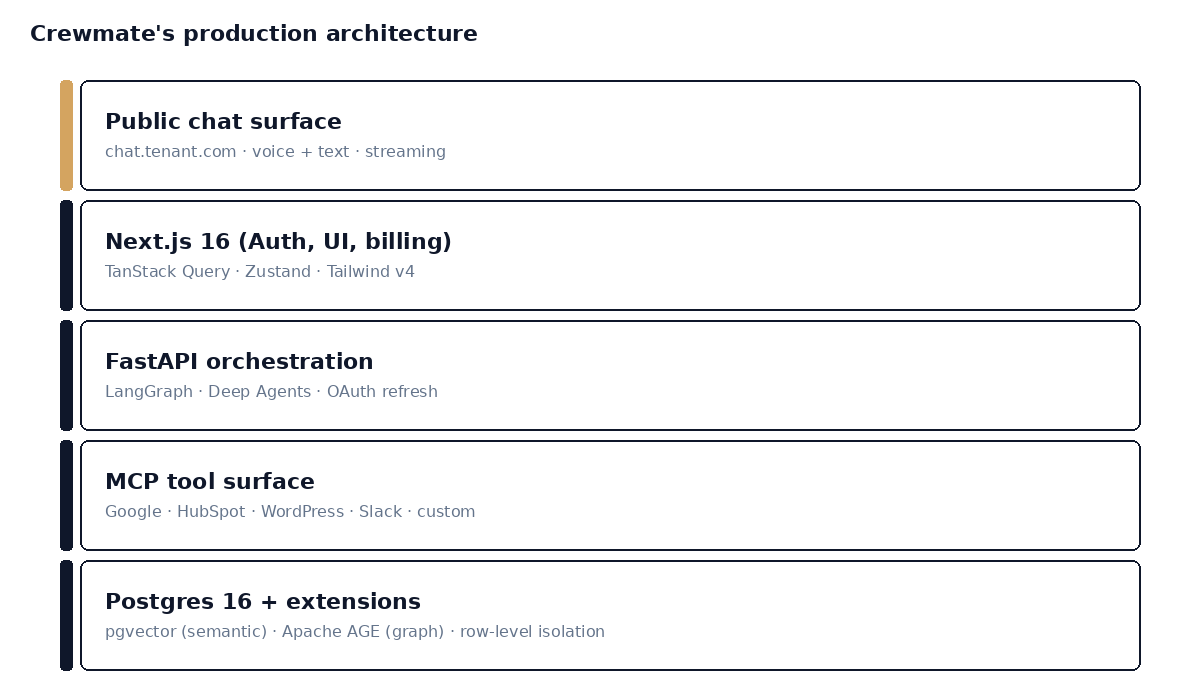
Each layer solves a different production problem. The bottom layer Postgres with pgvector and AGE is the foundation everything else depends on.
Memory: pgvector plus Apache AGE
An agent without memory forgets what your company sells between messages. An agent with naive memory (just dumping conversation history into the prompt) hits token limits in three sessions and gets slow and expensive.
Crewmate uses two memory systems together. pgvector handles semantic memory: the agent remembers facts and documents by meaning, not by exact text match. When the Sales agent needs to recall how your pricing tiers work, it queries the embedding index and gets the relevant chunks. This is the standard 2025 RAG playbook.
Apache AGE handles graph memory. Relationships between people, accounts, and projects live in a property graph. When the Support agent gets a ticket from Sarah at Acme Corp, it knows Sarah is the CTO, Acme is on the Pro plan, and the last three tickets were about a specific integration. Vector memory gives you facts. Graph memory gives you context. You need both.
Storing both in Postgres (rather than in a separate vector DB and a separate graph DB) is a deliberate decision. It means transactional consistency across memory writes, one connection pool to manage, one backup strategy. It's not the fanciest architecture. It's the one that survives Saturday at 3am.
Trust: approval gates, audit logs, row-level isolation
An AI agent in production needs to be supervisable. Crewmate makes this concrete at three layers.
Approval gates intercept tool calls. The agent doesn't send an email it asks to send the email, and the workflow pauses until a human in the right role approves. The agent doesn't update a CRM record it stages the change, the manager reviews, the change ships. This is built into LangGraph's interrupt mechanism, surfaced through Crewmate's permission system. It's not a feature you bolt on after a customer asks for it.
Audit logs record every action and every approval, with the user ID and timestamp. When a customer asks why an email went out, you can answer. When you're going through SOC 2 in a year, the auditor doesn't have a list of follow-up questions.
Row-level isolation between tenants means one workspace's data never leaks into another's. Every database query carries a workspaceId filter, enforced by Prisma middleware. The default behavior is safe; you have to opt out of the filter intentionally for super-admin paths. This is what makes multi-tenancy real rather than aspirational.
Scale: token budgets, model routing, lazy OAuth refresh
AI workloads scale in a particular pattern: usage explodes when a customer starts adopting, and the cost of token consumption can wreck your margins if you're not careful. Crewmate tracks token usage in an append-only ledger, enforces per-workspace budgets, and refuses to run when the budget is exhausted. Postgres triggers prevent UPDATE and DELETE on the ledger, which is the right paranoia for billing data.
Model routing means a chat doesn't have to use Opus. Most chats can use Sonnet, which is cheaper. Some can use Haiku, which is cheaper still. Crewmate's model selector lets each agent pick the model that matches its actual needs, and the super-admin can change defaults globally if the economics shift.
OAuth refresh is the unsexy piece. When an agent needs Google access, the token might be expired. Refresh inline, serialized by a Postgres advisory lock per connection so two concurrent runs don't both refresh and orphan a rotated refresh token. Distinguish permanent failures (refresh token revoked) from transient ones (Google had a 502). Surface the distinction to the resolver so a single dead connection doesn't take down the whole agent.
Each of these is a small thing. Together they're the difference between an agent that works in a demo and an agent that runs unsupervised for months.
The architecture rule
There's a rule that emerges when you ship enough production AI: the foundational decisions you make in the first month dictate the bugs you fight in month twelve. Picking the wrong storage layer means every memory bug is a database migration. Skipping approval gates means every customer incident is an emergency. Letting tokens flow unmetered means every quarterly review is an unpleasant conversation.
Crewmate makes these decisions for you upfront, and makes them defensible to anyone evaluating the stack.