
 Crewmate
 DeepAgent
 MemeMint
 Safenest
 Tapvault
 Bitvm
Bitvm
How to Ship a White-Label AI SaaS This Weekend
There's a particular kind of project that's killed more indie dev careers than any other: the multi-tenant SaaS template. You start it on a Saturday morning, full of energy. You write the auth system. You write the workspace model. You add invites. You realize you need RBAC. Then billing. Then Stripe webhooks. Then custom domains. Then the AI part you actually cared about. Six months later, you have a half-built foundation and nothing on the market.
Crewmate exists because of that pattern. The hardest 80% of building an AI workforce SaaS the multi-tenant scaffolding is the part that doesn't differentiate you. Skipping it is the difference between launching this weekend and launching next year.
What multi-tenant actually means
If you've never shipped a multi-tenant product, the word feels abstract. Here's what it concretely means: one running instance of your software, many companies using it, each one isolated from the others. Each tenant has their own users, their own data, their own subscription, their own branding, and ideally, their own domain. The codebase is one. The data is partitioned. The marketing surface is many.
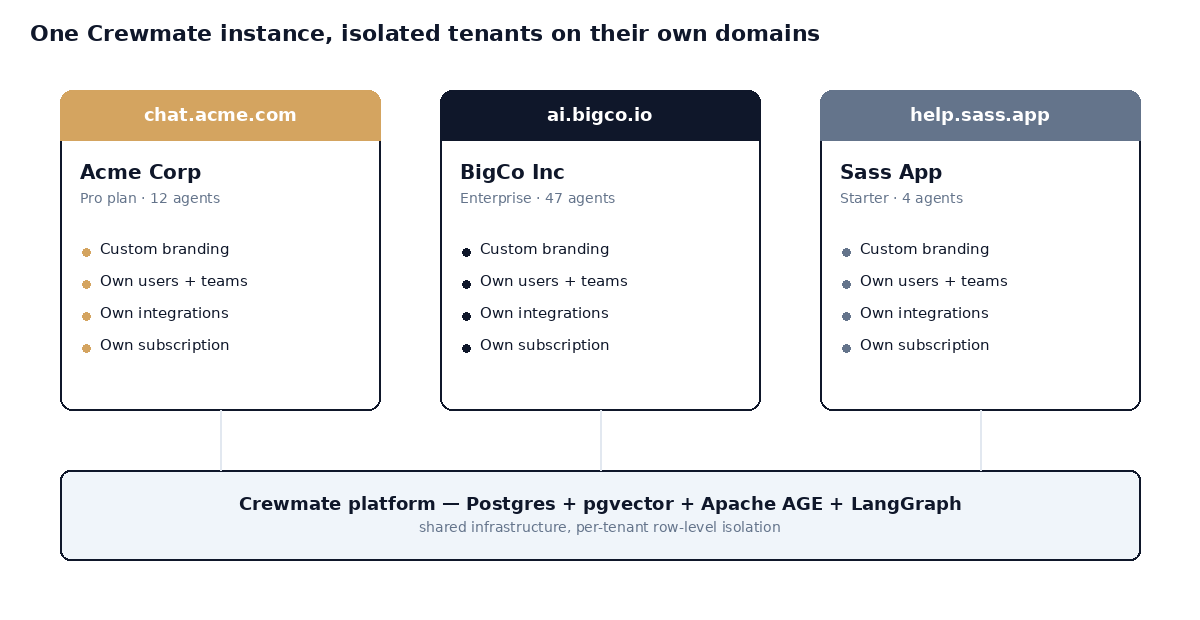
One codebase, one database. Each tenant gets their own subdomain, branding, users, and subscription.
Most AI products don't do this. They give every customer a flat, undifferentiated chat surface on the same domain. Customers can't put their own logo. They can't put it on their own subdomain. They can't even white-label it if they wanted to resell it. That's a strategic dead-end if your customers are agencies or anyone building on top of you.
What's pre-built
Crewmate ships with the boring 80%:
- Authentication argon2id passwords, DB-stored sessions with 30-day TTL, magic links, password reset, two-factor scaffolding.
- Multi-tenancy workspaces, memberships, teams, invite flows, role-based permissions (Owner / Manager). One Owner per workspace enforced at the DB level.
- Billing real Stripe integration. Plans, subscriptions (monthly + annual cadence), token-pack add-ons, webhooks as source of truth, idempotency keys on all grants. Not a mock.
- Super-admin surface platform-level admin can suspend tenants, issue manual credits, browse subscriptions, manage models. A real admin console, not a few SELECT queries.
- Internationalization next-intl wired throughout, English shipped, structure ready for more languages.
- Public chat surface per-tenant chat URLs at chat.theircompany.com, voice + text, streaming.
You don't write any of that. You skip to the part that matters.
What you customize
On top of the platform, you customize the agent roles, the integrations, the branding, and the pricing. Add an agent type your industry needs. Plug in an MCP server for a tool not in the catalog. Swap the color scheme to match your brand. Rewrite the marketing pages. Set your own Stripe prices.
All of this is application-level work. None of it requires touching auth, tenancy, or billing internals.
The stack is current
Crewmate uses the current versions of everything, not a 2022 React stack you'd have to migrate before deploying:
- Next.js 16 with the App Router, React 19, TypeScript in strict mode
- Tailwind v4 with the CSS-first config (no PostCSS plugins needed)
- Prisma 7 with the driver adapter pattern (pg via PrismaPg)
- Postgres 16 with pgvector for semantic search and Apache AGE for graph memory
- Python FastAPI for the agent runtime, LangGraph for orchestration, MCP for tool integrations
If you can write a React component and a Postgres query, you can ship a product on Crewmate.
Time to launch
Here's the honest math. Building this stack from scratch, with one developer working evenings and weekends, takes between four and nine months. We know because we built it. We know what each subsystem cost in hours. The auth alone is two weekends if you do it right (and most don't). Stripe webhooks are another full weekend with all the idempotency edge cases.
Crewmate ships those subsystems already done, tested, and integrated. Your weekend looks like: clone the repo, run prisma migrate, drop in your Stripe keys, customize the landing page, deploy to Vercel + a managed Postgres. By Sunday night, you have a multi-tenant AI SaaS on the internet.
Whether you build a niche tool for accountants, a customer-support platform for ecommerce stores, or a generalist AI workforce competitor, the foundation is the same. Skip the foundation. Ship the differentiator.