






Why a $29/month subscription replaces a 10–20% platform fee — and how to switch this week.

 By Admin
 2026-05-05
Stop Losing 20% of Your Income to Upwork. Here's the Bitcoin Escrow Built for Freelancers
If you are a freelance developer doing $80,000 a year on Upwork, you are paying that platform $8,000 to $10,000 every year for what is essentially payment processing. If you are on Fiverr, the number is closer to $16,000.
That is not a typo. Twenty percent. Sixteen grand. Out of money you earned with your skills.
Most freelancers pay these fees because they think there is no alternative. The platform brings the clients, after all, and the platform handles the escrow that prevents clients from disappearing with the work. But once you have your own client pipeline — once you are working with people who would pay you directly anyway — the platform is no longer providing the matching service. You are just paying it for trust.
And in 2026, you can buy that trust for $29 a month. Here is the math, the alternative, and how to switch this week.
The real cost of "free" platforms
Let's look at what actually happens to a freelancer's $10,000 invoice across the major platforms today:
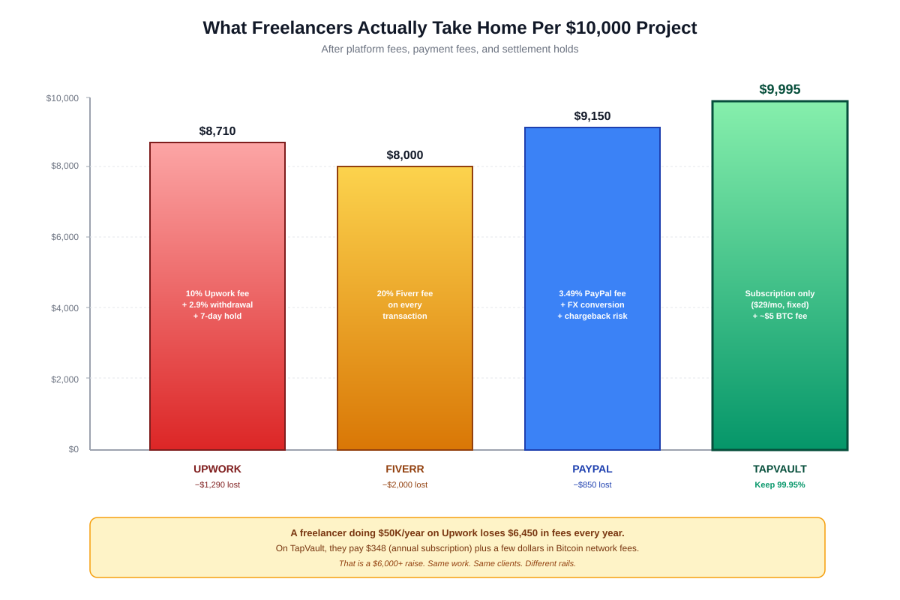
Upwork takes 10% of the gross, then charges another 2.9% to withdraw to your bank, then holds funds for 7 days. Out of $10,000, you keep $8,710. Fiverr takes 20% flat — you keep $8,000. PayPal looks better at $9,150, but your client can chargeback up to 180 days later. TapVault charges a flat $29/month subscription regardless of how many escrows you run or how large they are. On the same $10,000 invoice, you keep $9,995. Over a year of $50,000 in projects, that is the difference between $40,000 and $46,000+ in net income. Same work. Same clients. Different rails.
Why milestone payments matter for freelancers (and how TapVault handles them)
Lump-sum escrow works fine for fixed-scope projects, but most freelance work is not fixed-scope. You agree to a 6-week engagement, you bill weekly, and you need a way to release portions of the budget as you hit milestones.
TapVault's Freelance template is built specifically for this. When you set up an escrow, you can split it into milestones — for example, $2,000 on kickoff, $3,000 at design approval, $3,000 at staging deploy, $2,000 at final delivery. Each milestone gets its own release condition. The client can sign off on milestone 1 (releasing $2,000) without having to release the rest. If the project terminates early, the unreleased portion returns to the client without dispute.
This is the workflow agencies and senior contractors actually use. It is also the workflow that no Web2 freelance platform supports cleanly.
The platform comparison, fully honest
Here is how the major options stack up across the dimensions that actually matter to a freelancer:
| Platform | Take rate | Hold period | Currency | Reversible? |
|---|---|---|---|---|
| Upwork | 10% + 2.9% | 7 days | USD only | Yes |
| Fiverr | 20% | 14 days | USD only | Yes |
| PayPal | 3.49% + FX | Instant | Multiple | Yes (180d) |
| Stripe Direct | 2.9% + $0.30 | 2-7 days | Multiple | Yes (120d) |
| TapVault | $29/mo flat | Buyer-released | BTC | No |
TapVault is not for everyone. If you only get paid in USD by US-based small businesses, Stripe Direct is probably fine. If you are paid in Bitcoin, and especially if your clients are international, the math changes dramatically. You skip the FX, skip the reversal risk, skip the platform fee, and pay a flat subscription that does not scale with your income.
Three concerns I hear from freelancers, addressed
"My clients won't pay in Bitcoin."
True for most US/UK freelancers in 2026. But if you work with crypto-native clients (Web3 startups, DeFi protocols, blockchain agencies), they actively prefer to pay in BTC because it sidesteps their own FX and banking friction. TapVault also works alongside Stripe and Wise — it is not all-or-nothing.
"What if the client refuses to release funds?"
Either party can open a dispute, both submit evidence (chat logs, deliverables, invoice history), and the arbitrator makes a binding 2-of-3 multisig decision. If you have done the work and have the receipts, you win. This is the same workflow Upwork uses — except Upwork charges 10% of every transaction for it, and TapVault costs the same whether you have 0 disputes or 10.
"What if TapVault disappears?"
Every escrow includes a CSV timelock that automatically returns funds to the buyer after a configurable period (typically 30 days). The platform is mathematically incapable of trapping your money — that is the whole point of non-custodial design. When LocalCryptos shut down in 2023, in-flight escrow disputes took months to resolve and many never were. The non-custodial model is structurally safer for both freelancers and clients.
How to switch this week
- 1. Sign up at tapvault.tecneural.com — the Free tier handles your first escrow at no cost so you can test the flow
- 2. Set up your wallet — TapVault works with Xverse, Leather, OKX Wallet, or any modern Bitcoin wallet
- 3. Send a draft escrow agreement to your client — TapVault provides a one-link invitation flow that takes them about 5 minutes to accept
- 4. Run a small first transaction — say, $500 on a quick task — to make sure both sides are comfortable with the workflow
- 5. Once you and one client have done it once, scale up — most freelancers find their clients prefer it after the first time
For freelancers doing higher-volume work, the Pro tier ($29/month) lifts limits and adds milestone support. The Enterprise tier ($99/month) adds priority support and multi-user admin for studios.
Closing thought
The big freelance platforms were built in an era when escrow infrastructure was hard to build and clients needed centralized middlemen to feel safe. Both of those constraints are gone. The escrow infrastructure is now a configurable subscription. What remains of the big platforms is essentially a search engine — a way for clients to find freelancers, in exchange for 10–20% of every transaction for the lifetime of the relationship. That math was acceptable in 2015. It is increasingly indefensible in 2026.
If you have your own pipeline, your own brand, your own clients — you do not need to keep paying the platform tax. Try TapVault on one project and see.
GET TAPVAULT — IT'S FREE
TapVault is open and free. Reach out to Tecneural and we will send you the source code, deployment guide, and a 30-minute setup call.
Live demo: tapvault.tecneural.com
Get the code: Contact Tecneural — we ship the repository to qualified teams
Larger projects: Bitcoin L2, BitVM bridges, custom AI models — also Tecneural
About the author
Jeyakumar S — CEO at Tecneural. 16+ years building Bitcoin Layer-2 infrastructure, threshold signature systems (FROST, Schnorr aggregation), validator coordination, and cross-chain bridge primitives. Specializes in Rust and C++ cryptographic systems and consensus-layer engineering.
Contact Us
- 📞 Phone: +91 96555 17034
- 📧 Email: support@tecneural.com
- 🌐 Website: www.tecneural.com