
 Crewmate
 DeepAgent
 MemeMint
 Safenest
 Tapvault
 Bitvm
Bitvm
The 30-Day Pilot Plan for Your First Crewmate Agent
Most AI rollouts fail because they're done all at once. A team decides AI is important, buys a license, deploys to 50 people in week one, watches the project fizzle out by month three, and concludes 'AI isn't ready.' The AI was ready. The rollout wasn't.
The opposite approach works better: a small, structured pilot. One agent, one role, one human supervisor, four weeks. Below is the version that works, broken into the four weeks and what to do in each.
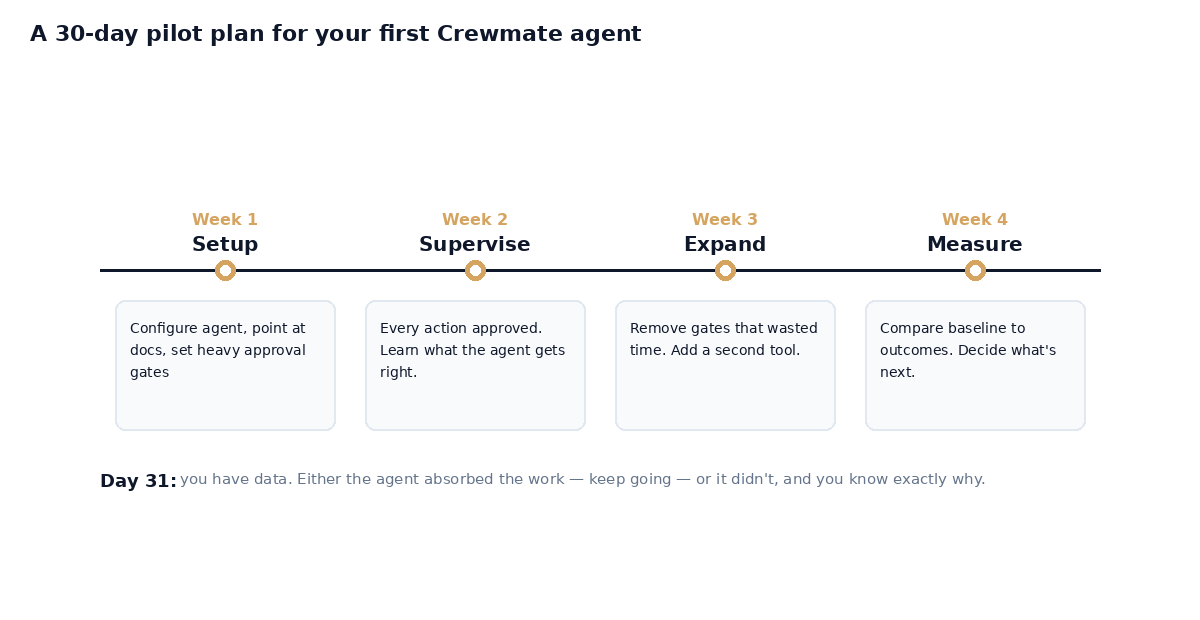
Four weeks. Setup, supervise, expand, measure. By day 31, you have data.
Before week 1: Pick the right role
The biggest predictor of pilot success isn't which agent you configure — it's which role you choose to automate first. The right choice has three properties: it's high-volume (so you get many data points fast), it's well-documented (so the agent has source material to work from), and it's low-stakes per individual decision (so an early mistake is cheap, not catastrophic).
Good first roles: First-line customer support, lead qualification, internal documentation maintenance, content drafting, status reporting.
Bad first roles: Closing sales, sensitive customer escalations, HR communications, anything that touches payroll or contracts. Save those for later, after you've calibrated trust.
Week 1 — Setup
In week one, you're not trying to get value yet. You're trying to get the agent configured correctly. Spend a day creating the agent in Crewmate: pick the role, point it at the right knowledge sources (your docs, your help center, your past tickets — whatever's relevant), set the initial prompt, configure approval gates aggressively. Every action the agent might take should require human approval in week one. Yes, everyone. The point isn't speed yet; the point is observation.
Set up your baseline metrics. If this is a Support agent, what's your current ticket resolution time, escalation rate, customer satisfaction? Write the numbers down. You'll compare against them at the end of the pilot.
Spend the rest of the week watching the agent work. Don't intervene unless something is going badly wrong. Just watch.
Week 2 — Supervise
Week two is when the actual training happens. The agent is now running with full approval gates, and your job is to be the approver. Every email it wants to send, you read it first. Every action it wants to take, you authorize. This is tedious. It's work.
As you approve, you'll start noticing patterns. Some types of actions the agent gets right consistently — you find yourself rubber-stamping them. Other types of actions the agent gets wrong in characteristic ways — you find yourself editing the same kind of mistake repeatedly. Write down what you notice.
By the end of week two, you should have a list of actions the agent can be trusted with unsupervised, and a list of actions that need either better prompting or sustained approval gates.
Week 3 — Expand
Week three is when the agent gets more autonomy. Use what you learned in week two to remove the approval gates on actions the agent has been getting right consistently. Add or refine the prompts where it was getting things wrong. If there's a second tool you wanted the agent to use, add it now.
This is also the week to give the agent slightly harder tasks. If the Support agent was only handling tier-1 tickets, let it try to triage tier-2 tickets and either resolve them or pass them on. If the Sales agent was just qualifying inbound leads, let it draft outbound personalization for a small batch of prospects.
Keep watching. The expansion is also a test — does the agent still hold up when given a wider scope?
Week 4 — Measure
Week four is the measurement week. Pull the baseline numbers from week one. Pull the current numbers. The difference is your pilot result.
The numbers that matter depend on the agent's role, but the framing is consistent: how much work did the human team avoid? How much faster did the work happen? How much cost did we avoid (compared to the hire we would have made instead)? Are customer or internal stakeholder satisfaction scores stable, up, or down?
Document what worked and what didn't. The pilot isn't really about whether to keep going — most pilots that get to week four work well enough to keep going. The pilot is about figuring out what to do next: which second agent to deploy, which approval gates to relax, which workflows to expand.
Day 31
At day 31, you have something you didn't have at day 0: real data about how AI fits into your business. Not a vendor demo, not an analyst report, not a Twitter thread. Actual numbers from your actual workflows.
Whatever your decision after that — expand the AI workforce aggressively, expand cautiously, stay small, or stop — it's now an informed one. Most companies skip this step. The companies that do well in this transition are the ones who didn't.