
 Crewmate
 DeepAgent
 MemeMint
 Safenest
 Tapvault
 Bitvm
Bitvm
The Real Cost Math: What a Crewmate Subscription Replaces
Most software is priced against substitutes. A CRM costs less than what you'd pay to track leads manually. Email automation costs less than what you'd pay a junior marketer to send the emails by hand. The pricing equation assumes you'd otherwise hire a person, and tries to come in cheaper.
This works for AI workforce software too, but the math is more dramatic than most people realize. The reason is that companies tend to compare a SaaS subscription to a salary, and forget the salary isn't the salary.
A salary isn't a salary
When a company decides to hire a $65,000 SDR, the actual annual cost is not $65,000. It's $65,000 plus payroll taxes (roughly 8%), plus benefits (health insurance, retirement match call it 18% of base), plus equipment ($2,500 amortized), plus management overhead (your time spent supervising them usually estimated at 5-10% of their salary in opportunity cost), plus the cost of the hiring process itself (recruiter fees, your time interviewing amortized over a typical 18-month tenure, that's another 8% of comp).
The number you actually paid:
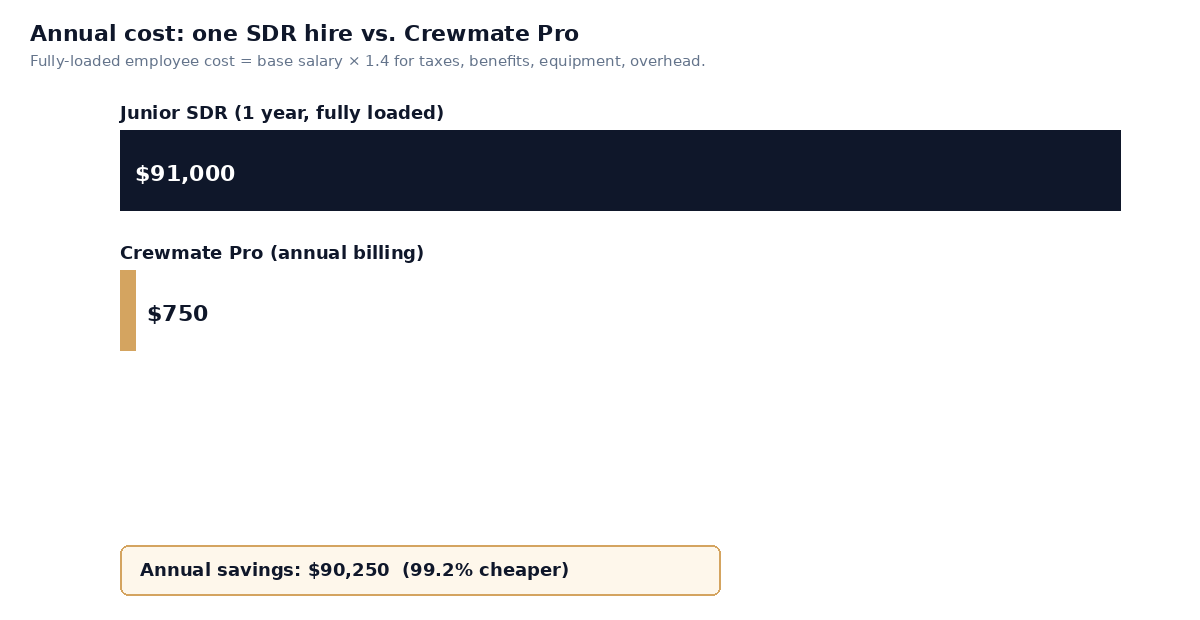
Fully-loaded SDR cost vs. annual Crewmate Pro subscription. The math doesn't require interpretation.
That's the real comparison. A junior SDR at $65,000 base salary actually costs the company about $91,000 in the first year. The marketing brochure says $65k. The P&L says $91k.
What you get for $750/year
Crewmate Pro at annual billing is $750 per year. Twenty-five AI agents, ten million tokens monthly, ten teams. Approval gates, audit logs, custom domains for the public chat surface. Stripe billing for your own customers if you're reselling. Real production infrastructure.
For an apples-to-apples comparison: Crewmate Pro for one year replaces 0.8% of the cost of one fully-loaded SDR hire. The same agent's capacity is several SDRs worth of qualification work. If you previously planned to hire three SDRs over the next eighteen months, the math against Crewmate Pro looks something like:
- Three SDR hires over 18 months, fully loaded: roughly $400,000+
- Crewmate Pro over the same period: $1,125
- Cost avoidance: ~$400,000, or roughly 99.7% lower spend
Where the math is misleading
If we stopped here, this would be marketing puffery. The honest version requires acknowledging four things:
First, AI agents don't fully replace SDRs. They replace 70-85% of an SDR's actual workload the qualifying, the follow-ups, the CRM updates, the meeting scheduling. The 15-30% that's relationship-building and judgment-calling still needs a human. So the right way to read the math is not 'eliminate three SDRs' but 'avoid hiring three SDRs by automating most of what they would have done'.
Second, tokens cost money. Crewmate Pro includes 10M tokens. Heavy usage past that requires token packs (priced separately). Realistic SDR-style usage is well within the bundled allowance, but agents doing heavy content generation can push past it.
Third, opportunity cost. The time you spend setting up agents and refining their prompts is real. Not free. Typically a half-day to a day per agent, with another few hours each month maintaining them.
Fourth, judgment. There are real failure modes an agent that responds to a sensitive inquiry without the right empathy, a follow-up that goes out when a human would have known to hold back. The approval gates exist to catch these, but they require attention to keep working.
None of these reverse the math. They just qualify it from 'AI is 99% cheaper than humans' to 'AI plus a small human supervision layer replaces most of what those humans were doing at a fraction of the cost.'
The CFO's question
The most useful question a CFO can ask isn't 'should we replace people with AI.' It's: 'For each hire we have planned this fiscal year, what fraction of that role's actual work is captured in the first six items on a Crewmate agent capability list, and could we delay or cancel the hire by deploying that agent instead?'
That's a productive question because it's answerable. Walk through each open req. For each role, list the recurring tasks. Count which ones an agent could do well, which ones an agent could do with supervision, and which ones genuinely need a human. If the first two buckets cover 70%+ of the role, the agent absorbs the role. If they cover 30-70%, the agent absorbs the bottom of the role and you hire at a higher level. If they cover less than 30%, you still hire.
The companies operating well in 2026 aren't the ones firing people. They're the ones running through every open req with this framework and watching their hiring plan compress without their output dropping.
The decision is small
$750/year is, for most companies, the cost of a few business lunches. The risk profile of trying Crewmate against an open hiring slot is minimal. The upside, if the math holds, is significant.
Run the framework on one open req. If the agent absorbs most of the work, you've found your first cancelled hire and the budget for the next twelve months of Crewmate paid for itself in a week. If it doesn't, you've lost a few hours of evaluation time and you proceed with the original plan.
That's the kind of asymmetric bet a CFO should be making in 2026.