
 Crewmate
 DeepAgent
 MemeMint
 Safenest
 Tapvault
 Bitvm
Bitvm
The Tier-1 Revolution: How AI Agents Handle 70% of Support Tickets
Walk into any support team and ask the senior agent what they do all day. They'll tell you about a difficult escalation. Then they'll tell you about a tricky bug they helped resolve. They might mention a customer they saved from churning. What they probably won't tell you is what they actually did most of the day, because it's so boring they've stopped noticing it: password resets, billing questions, and 'where do I find' tickets.
That's tier-1. It's 70% of inbound volume in most support orgs. It's 5% of the value. And it's why your best support people leave.
Crewmate's Support agent was built to make that math go away.
The 70/20/10 split
Most support inboxes follow a predictable distribution. About 70% of incoming tickets are recurring questions that have been asked many times before — they're already answered in your help docs, your FAQ, or your past ticket history. About 20% are standard issues that need a human but follow a well-understood pattern. The remaining 10% are genuinely novel - outages, edge cases, customers in unusual states.
If you look at where customer impact actually happens, it's almost entirely in that 10%. A great senior agent saving a frustrated customer is what builds loyalty. A great senior agent answering 'how do I reset my password' is what builds burnout. The work is inverted from the value.
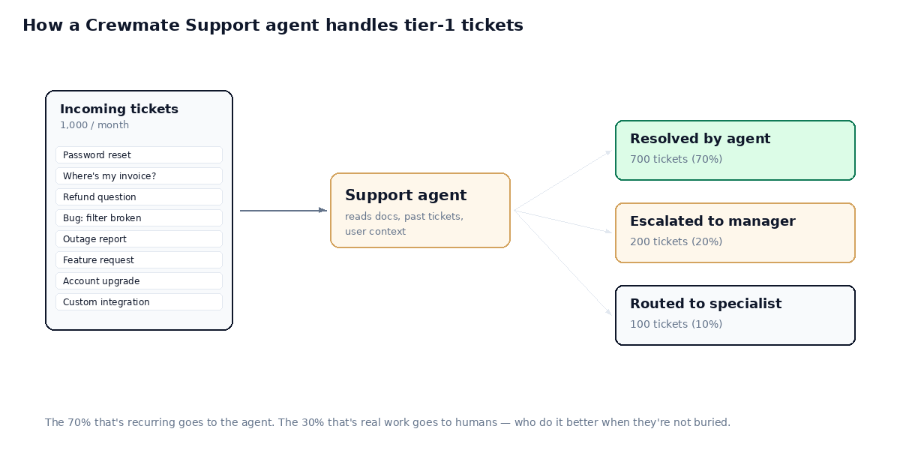
Incoming tickets get triaged by the Support agent. 70% resolved. 20% escalated to a manager. 10% routed to a specialist.
Why most AI support fails
Plenty of companies have tried to drop an AI chatbot into their support flow. Most of these projects quietly die within six months. The reasons are consistent: the bot hallucinates because it wasn't grounded in the company's actual docs. The escalation handoff to a human loses context, so the customer has to repeat themselves. There's no audit trail when something goes wrong. And the bot can't actually do anything — it can answer questions, but it can't reset a password, refund an order, or escalate a ticket. It's a glorified search bar pretending to be an employee.
Crewmate's Support agent is structurally different. It reads from your actual help docs and past ticket history via the workspace's knowledge base. It can take real actions (refunds, password resets, account changes) but every action passes through approval gates configured by the workspace manager. When it can't handle a ticket, it hands off to a human with full context — the conversation transcript, the customer's account state, what the agent already tried, and what the agent thinks should happen next.
The handoff is the product
If you take one thing from this article, take this: in production support AI, the handoff is more important than the resolution.
A perfect bot that answers 99% of tickets but loses the 1% by handing off badly is a worse product than a decent bot that answers 70% well and hands off the other 30% with context. The customer remembers the bad handoff, not the 99 good resolutions before it.
Crewmate preserves three things in every handoff: the full transcript with the customer (so they never have to repeat themselves), the agent's reasoning about why escalation was needed (so the human starts informed, not confused), and any actions the agent already took (so the human doesn't redo work or undo correctly-taken steps).
The metrics that actually matter
Support orgs deploying Crewmate usually start by measuring the wrong things. Time-to-first-response is obvious to measure but mostly meaningless when the AI responds in 800ms by default — you'll always win. CSAT scores are interesting but lagging.
The metrics that matter for production AI support:
- Resolution rate (agent closes without escalation) — measures whether the agent actually works
- Re-open rate (resolved tickets coming back) — measures whether the resolution was real
- Escalation quality (human satisfaction with handoff context) — measures the seam between AI and human
- Agent burnout markers (sick days, turnover among human team) — measures the human side of the equation
If resolution rate is up but re-open rate is also up, your agent is closing tickets too aggressively. If escalation quality is low, your handoff prompts need work. If agent burnout doesn't improve, you've automated the wrong tasks.
What changes for your human team
The change isn't 'fewer support people.' Most orgs keep their headcount roughly steady but change what their humans do. The senior agents who used to answer password resets now own the escalation queue, the playbook updates, and the customer-success outreach to high-value accounts. They get to do the work that made them senior in the first place — the work the AI can't do.
The pattern is consistent across teams we've worked with: turnover drops. Hiring becomes easier because the role is more interesting. And the support function shifts from being a cost center the company tolerates to a function that actually contributes to retention.
The shift takes about a quarter. Most teams underestimate how much of that quarter is spent re-training humans to do harder work, not deploying the AI.