
 Crewmate
 DeepAgent
 MemeMint
 Safenest
 Tapvault
 Bitvm
Bitvm
Why Do We Build Crewmate on the Model Context Protocol?
Five years ago, every SaaS company shipped its own integration API. To plug a tool into your AI workflow, you wrote a custom connector for that vendor's API, wrote another one for the next vendor, wrote another one for the next. Multiply by every tool an enterprise uses and you have hundreds of custom integrations - each maintained, each potentially broken by a vendor's API change, each a small recurring tax on your engineering team.
The Model Context Protocol (MCP) is the way out of that pattern. A Crewmate is built on it. Here's why it matters.
What MCP actually is?
MCP is an open specification published by Anthropic that defines a standard way for AI agents to discover, describe, and invoke tools. Instead of writing a custom adapter for every API your agent needs to talk to, you write (or use) an MCP server for that tool. Your agent speaks MCP. The MCP server speaks the tool's API on the other side. The agent and the tool never need to know about each other directly.
This is the same pattern as USB, HTTP, or any other protocol that solves a many-to-many integration problem. Before USB, every peripheral had its own port. After USB, every peripheral spoke a standard. MCP is the AI tool equivalent.
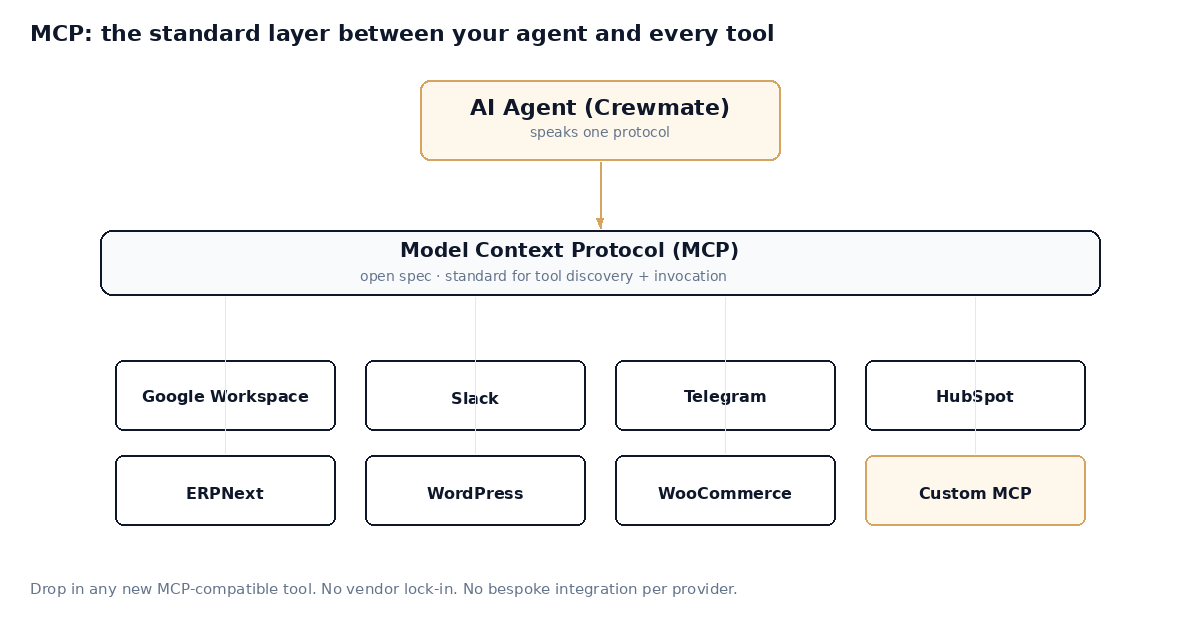
One protocol between the agent and every tool. Drop in any MCP-compatible server. Build your own proprietary systems.
What Crewmate Ships With?
Crewmate's MCP layer ships with eight first-class integrations covering the tools most businesses actually use:
- Google Workspace Gmail, Calendar, Drive, Docs
- Slack channels, DMs, file uploads
- Telegram bot messaging
- HubSpot CRM contacts, deals, companies, activities
- ERPNext invoices, customers, items, accounting
- WordPress posts, pages, media, comments
- WooCommerce orders, products, customers
- Custom MCP bring your own server URL
Each is a workspace-level configuration. The owner enters credentials once. Every agent in the workspace can use those tools, gated by the agent's role and the manager's approval rules. Adding a new integration takes about 90 seconds paste a URL, paste a credential, save.
Why does "Custom MCP" matter more than the Prebuilt ones?
The eight prebuilt integrations cover most use cases for most businesses. But every company has at least one proprietary system an internal CRM, a homegrown billing tool, a legacy ERP that no third-party integration will ever cover. Historically, those systems were excluded from any AI tooling because building a custom integration wasn't worth the effort.
MCP makes building those custom integrations cheap. An MCP server is a small program (often less than 200 lines of code) that wraps your internal API and exposes it as MCP tools. You build it once. It works with Crewmate, with any other MCP-compatible AI product, and with Anthropic's own Claude Code. The same server serves three or four downstream consumers, and you maintain it in one place.
The shift is significant. The custom integration that used to cost weeks of engineering is now a day's work, and pays dividends every time you adopt another AI tool.
Vendor lock-in, defused
There's a strategic point here worth stating directly. AI product vendors have an obvious incentive to lock you in. The harder it is to take your integrations elsewhere, the more leverage they have over you. Pre-MCP, the integration work you did with a vendor was tied to their proprietary connector format, and switching vendors meant rebuilding integrations.
MCP changes the math. The MCP servers you write (or buy) are yours, not the AI vendor's. If you switch from Crewmate to a different AI workforce platform later, your MCP servers come with you. The vendor doesn't own your integration layer.
This is the kind of architectural choice that doesn't make the demo video. It shows up two years in, when you decide to switch vendors or add a second one in parallel, and you discover that you actually can.
The Protocol is Winning
MCP is being adopted across the AI ecosystem at unusual speed. Anthropic, OpenAI, and Google have all signaled support. Major SaaS vendors are publishing official MCP servers for their products. Open-source MCP servers exist for hundreds of common tools. The protocol has crossed the threshold from 'interesting standard' to 'de facto standard you should design around.'
The crewmate's bet was that this would happen. So far, the bet looks right. The integration layer that took years to build for chat-era SaaS will take months for AI-era workforce products, because MCP did the hard standardization work upfront.